

The blank page is the problem, not you. Most people who say they hate journaling do not hate thinking about their day. They hate the performance around it: the leather-bound notebook, the neat handwriting, the unspoken rule that a real entry has to run for three pages before it counts for anything.
A prompt removes the blank page, which is the only part most people were ever stuck on. The catch is that most prompt lists are written by people who genuinely enjoy writing, and their lists show it. Thirty-day challenges, fifty questions, a new theme for every month. If you already dislike journaling, that is not a solution. It is homework.
Why most journaling advice fails people who dislike writing
Published prompt lists tend to assume enthusiasm. One popular collection from 2017, Jennie Moraitis’s “40 Awesome Journaling Prompts”, was written with bullet journals, art journals and creative retreats in mind. It is a lovely list. It is also forty questions long.
Other collections lean on structure that can feel like a syllabus. A 30-day prompt series shared on Reddit runs day by day, from day 15 (“what are three things you are grateful for right now?”) through day 16 (“reflect on a lesson you learned from a recent mistake”) and onwards. That format works beautifully if you like ticking off boxes. If you do not, missing day four is enough to make you abandon the whole thing.
Longer lists have the same issue. A 2023 piece from Wit and Delight offers prompts for managing emotions, including questions such as “what hurts right now, and how can I find relief?” and “when I look in the mirror, what do I see?”. These are good questions. They are also heavy, and heavy is exactly what a reluctant journaler avoids at 10pm on a Tuesday.
The smallest version that still produces something useful
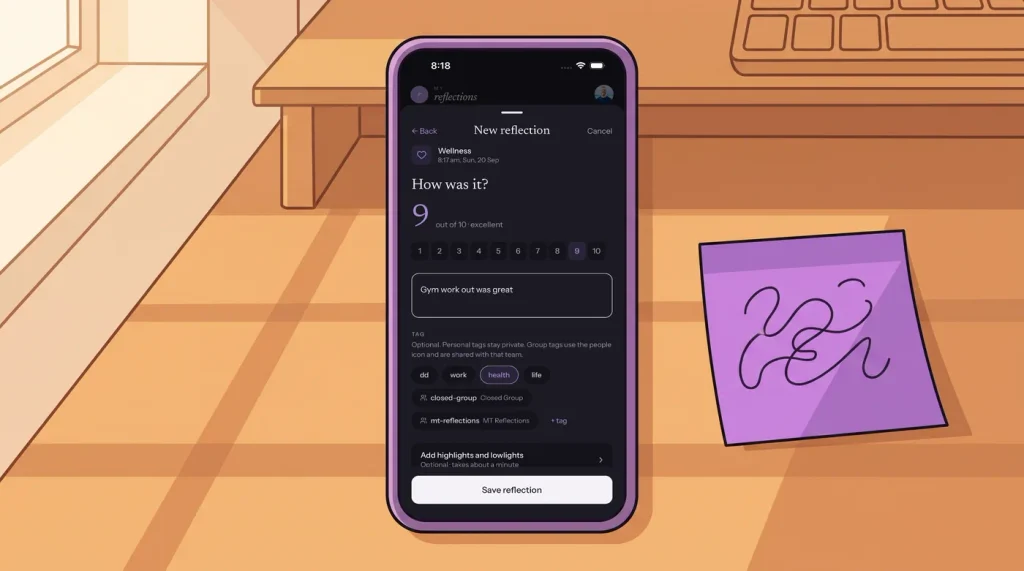
Strip journaling back to two things: a rating and a note. That is the whole loop in My Reflections. You open Capture, score how something went from 1 to 10, and write one short line about why. It takes about two minutes. There is no blank page to perform for, and no streak to protect.
It sounds too small to matter, and that is the point. A single line you actually write beats five paragraphs you keep meaning to write. A rating gives you something to compare later. The note gives the rating meaning. Together they turn a fuzzy week into a record you can scan, rather than a document you avoid.
Daily journaling prompts you can answer in one line
Every prompt below is designed to be finished in one sentence. If a question pulls more out of you, keep going. If it does not, stop and close the page. Both outcomes are correct.
Four prompts for the morning
Morning prompts work best when they set direction instead of creating a task list. The 2017 self-reflection set includes the question “when I wake up in the morning, how do I most want to feel?”, which is answerable in three words. Others to try:
- When I wake up in the morning, how do I most want to feel?
- What does my ideal day look like, from morning to night?
- How am I feeling right now?
- What is going well in my life at the moment?
Four prompts for a hard day
On a difficult day, keep the question blunt and the answer short. Emotion-focused lists offer lines like “what hurts right now, and how can I find relief?” and the simple scale question “on a scale of 1 to 10, how is my heart today?”. A number counts as a full entry. So does one word.
- What hurts right now, and how can I find relief?
- What is draining my energy?
- What do I need to give up, say no to, or let go of?
- On a scale of 1 to 10, how is my heart today?
Four prompts for days when nothing happened
Flat days are the ones that kill journaling habits, because there seems to be nothing to report. Prompts built around small positives solve that. A 2025 mental health prompt collection suggests “what are three things that made me smile today?” and “who has positively impacted my life recently, and how?” as starting points.
- What are three things that made me smile today?
- Who has positively impacted my life recently, and how?
- What are three things I am grateful for right now?
- What are the things in my home that are the most “me”?
Four prompts for looking back
Reflection does not have to happen in the moment. A self-discovery list published on Medium includes “what advice would I give to my younger self?”, while clarity-focused prompts such as “what would make me happy right now?” and “what is standing in the way of that happiness?” work well as a pair. Answer the first, then the second, and you have a two-line entry with a bit of teeth to it.
- What advice would I give to my younger self?
- Reflect on a lesson you learned from a recent mistake.
- What would make me happy right now?
- What is standing in the way of that happiness?
A seven-day rotation you can copy
One prompt per day, no repeats within the week. Read the prompt, write a sentence, move on.
| Day | Prompt | Why it stays short |
|---|---|---|
| Monday | When I wake up in the morning, how do I most want to feel? | Sets direction without building a task list |
| Tuesday | How am I feeling right now? | One word or one number is a valid answer |
| Wednesday | What is draining my energy? | Names the thing you would otherwise carry all week |
| Thursday | What is going well in my life? | Balances a week spent solving problems |
| Friday | Who has positively impacted my life recently, and how? | Points the attention outward for one line |
| Saturday | What would make me happy right now? | Small, immediate and answerable on the spot |
| Sunday | Reflect on a lesson you learned from a recent mistake. | Turns one slip into something reusable |
What to do when you skip a day
Skip it and start again. Nothing about reflection requires an unbroken run, and treating a missed day as failure is the fastest way to quit entirely. The scolding streak counter is a design choice, not a requirement, and it is one that punishes exactly the people this habit is meant to help.
If you want a re-entry point after a gap, use the shortest prompt on your list. “How am I feeling right now?” takes seconds and gets you back into the loop without a confession about where you have been.
Why one line is enough when you come back to it
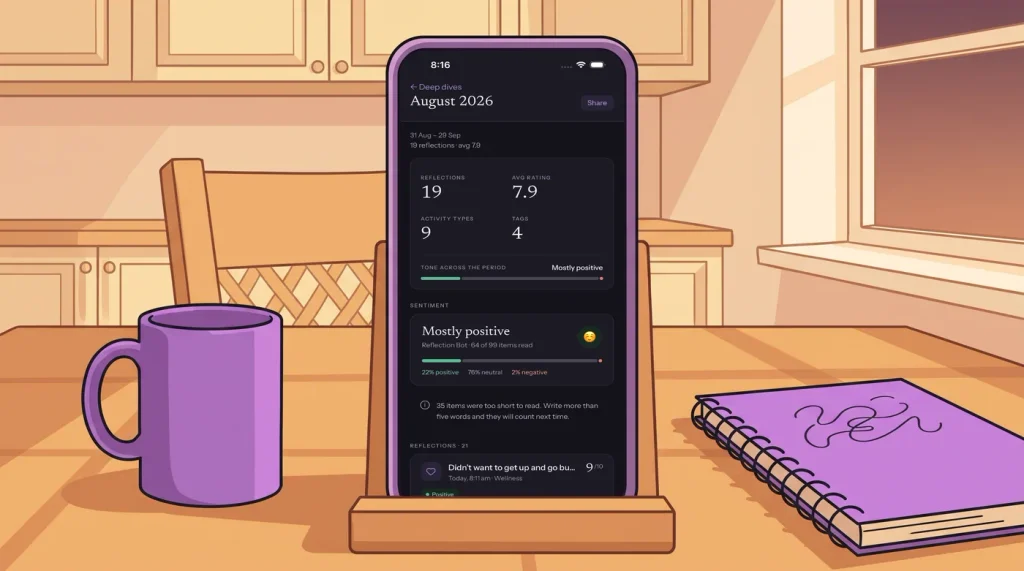
A single sentence is thin on its own. Forty single sentences are not. Once entries accumulate, patterns show up that you would never notice day to day: the same energy drain appearing every Wednesday, a mood drop tied to a particular project, a run of good weeks after a change you had almost forgotten making.
This is where a simple rating plus note format earns its place. Tag the entries, and a month of two-minute notes becomes something you can search by person, project or feeling. The My Reflections app supports this with tags, goals and deep dives over a date range you choose, and keeps notes private by default, with a CSV export if you want your data out. Free covers the core habit. Professional is USD $2.99 a month after a 7-day trial, and the same account works on iPhone, Android and the web.
Make the prompts sound like you
Published prompts are starting points, not scripts. If “how is my heart today?” feels too soft, replace it with “how is my head today?” or “what is my stress level right now?”. The wording matters far less than whether you will actually answer it.
Rewrite any prompt that makes you cringe, cut any prompt you have skipped three times, and keep the two or three that reliably produce a sentence. A short list you use beats a comprehensive one you admire from a distance.
Frequently Asked Questions
How long does a daily journaling entry need to be?
One sentence is enough. A rating plus a short note takes about two minutes and still gives you something you can compare later. If a prompt pulls more writing out of you, follow it. If it does not, stop at the first line and close the page. Length is not the measure of whether reflection worked.
What if I sit down and cannot think of anything to write?
Use a prompt built for flat days, such as naming three things that made you smile, or a single question like “how am I feeling right now?”. If the honest answer is “nothing much”, write that. A flat entry is still a data point, and it keeps the habit alive.
Do I have to write every day for it to be worthwhile?
No. A regular habit matters more than an unbroken one, and a gap costs you nothing except the entries you did not write. If you miss several days, restart with the shortest prompt on your list rather than trying to catch up. There is nothing to catch up on.
Can I use the same prompt every day?
Yes, and repeating one question can be more useful than rotating through many. Answering “what is draining my energy?” every day for a month shows you a pattern. Add a tag to each entry so you can pull the repeats together and read them side by side later.
Try the two-minute version tonight.
Reflecting is free, on iPhone, Android and the web. Professional has a 7-day trial.
Get the appKeep reading
Reflection practice
Daily Reflection Habit: Two Minutes, One Rating, One Note
Build a daily reflection habit in two minutes: one rating, one note, and a searchable record that compounds over ordinary weeks.

Reflection practice
How to Build a Reflection Habit That Sticks in 2026
Learn how to build a reflection habit that survives busy weeks, with small daily prompts, a simple review rhythm, and tools that keep your notes useful.