
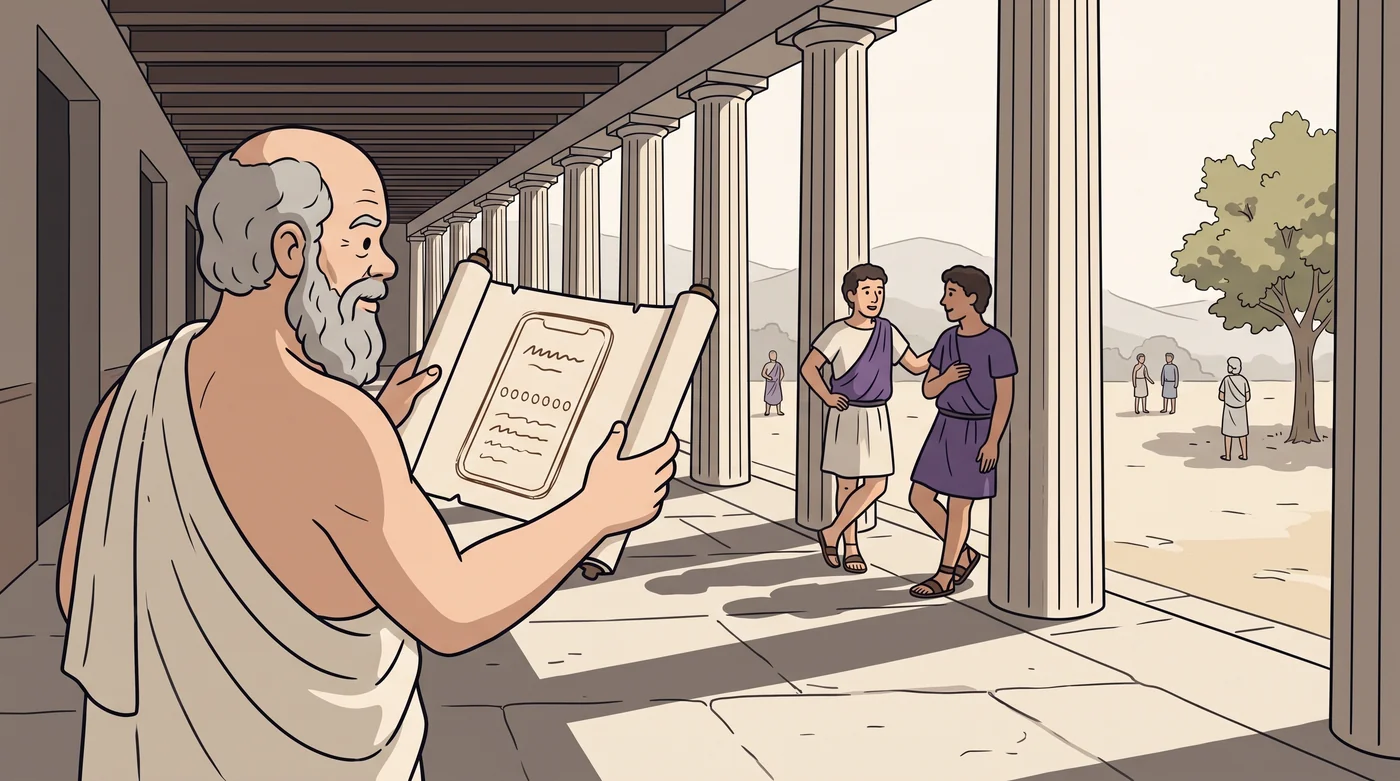
“Just write about your day.” It sounds like the friendliest advice in the world, and for a lot of people it is exactly where reflection stops. You open a blank page, write two lines about being tired, and close it again. Then you assume you’re not the reflective type.
I don’t think the problem is you. I think it’s the blank page. And some of the people who have thought hardest about thinking would, I suspect, agree.
Thursday 19 November is World Philosophy Day, which UNESCO marks every year on the third Thursday of November. UNESCO describes philosophy as “an inspiring discipline as well as an everyday practice”, and an everyday practice is what this post is about. Three thinkers, writing more than two thousand years apart, have something useful to say about why reflection works better with a bit of structure. I’ll let them make the case first, and then explain honestly where My Reflections fits, and where it doesn’t.
Socrates: examination is a habit of questions
The most famous line about reflection comes from a courtroom. In Plato’s Apology, Socrates is on trial for his life. Asked to propose a penalty, he says he can’t simply go away quietly and stop his questioning, because “to talk every day about virtue and the other things about which you hear me talking and examining myself and others is the greatest good to man, and that the unexamined life is not worth living” (Apology 38a, Fowler translation).
It’s worth reading that line in its setting, because the poster version misses two things.
First, Socrates says “every day”. Examination isn’t a once-a-year retreat. It’s a habit.
Second, his examination wasn’t a quiet mood. It was questioning, of himself and of others: what do you mean by that, how do you know, what follows if it’s true? Socrates didn’t journal, and I won’t pretend he’d have loved an app. But his method was built on asking specific questions, not on waiting for insight to arrive.
That’s the first piece of structure: an examined life is made of questions you actually ask, again and again.

John Dewey: a question holds thinking in a channel
More than two thousand years later, the American philosopher John Dewey tried to pin down what reflective thinking actually is. In How We Think (1910), he defined it as “active, persistent, and careful consideration of any belief or supposed form of knowledge in the light of the grounds that support it, and the further conclusions to which it tends”.
Notice the words: active, persistent, careful. Reflection, for Dewey, is not the same as letting thoughts drift. He was blunt about what makes the difference: “Demand for the solution of a perplexity is the steadying and guiding factor in the entire process of reflection.” Without a problem to solve, he wrote, “the course of suggestions flows on at random”. But “a question to be answered, an ambiguity to be resolved, sets up an end and holds the current of ideas to a definite channel.”
That sentence could be the brief for every good journaling prompt.
Dewey also described five “logically distinct steps” in a complete act of thought: a felt difficulty; locating and defining it; suggesting a possible solution; reasoning through what that suggestion would mean; and further observation and experiment until you accept or reject it. You don’t need to follow that as a checklist. But it shows that reflection has a shape, and it ends in something you test, not just something you feel.
He was also honest that it isn’t comfortable. “Reflective thinking is always more or less troublesome,” he wrote, because it means putting up with doubt for a while instead of accepting the first idea that seems plausible. Structure doesn’t remove that discomfort. It just gives it somewhere to go.
Donald Schön: reflecting in the moment, and afterwards
In 1983 Donald Schön published The Reflective Practitioner: How Professionals Think in Action. He opens the book with the idea that skilled practitioners know more than they can put into words (Schön, 1983): the nurse, the architect or the teacher who handles a situation well but would struggle to explain the rule they followed.
Schön’s best-known idea is that professionals reflect while they work. When something surprising happens, a good practitioner doesn’t just push on with the plan. They notice the surprise, rethink how they’ve framed the problem, and try something on the spot. In that moment, Schön argued, the practitioner is acting like a researcher of their own case rather than simply applying established theory and technique (The Reflective Practitioner, 1983). Writers on Schön, such as IRISS’s guide to reflective practice, pair this reflection-in-action with reflection-on-action: looking back afterwards at what happened, why you acted as you did, and what you might do differently. That second kind is often where reflective writing comes in.
What I take from Schön is about timing. The surprise happens in the moment. The learning is easiest to catch soon after, while you can still remember what you noticed. A reflection written a week later is mostly a reconstruction.
What the three have in common, and where structure can go wrong
Put them side by side and a pattern appears. Socrates asks questions, daily. Dewey says a question is what keeps reflection from drifting. Schön says the moment just after the work is where practice can be examined. None of them describes reflection as staring at an empty page and hoping.
In the spirit of the day, it’s worth being critical too. Structure can go wrong. A prompt can turn into a script you answer on autopilot. A form with fifteen fields can become a chore that crowds out the one honest thought you had. Dewey’s whole point was careful thinking, not tidy paperwork, and Schön was arguing against professionals who apply rules without looking at the situation in front of them. Good structure is a scaffold: it should hold you up, then get out of the way.
I’ll also be clear about what I’m doing here. None of these thinkers wrote about reflection apps, and reading them as a case for structured journaling is my interpretation, not theirs.
Why I built My Reflections around questions
Long before the app, most of my reflecting happened inside structures: project reviews and sprint retrospectives at work. And when I wrote about why I started My Reflections, the turning point I described came from a single, innocent question from a family member. Not a blank page. A question.
So the app starts with structure rather than a blank page. A reflection is a type of moment, such as a meeting, a task or a daily check-in, then a rating from 1 to 10, then a short note. The rating forces a judgement. The note asks you for a reason. That’s a very small version of Dewey’s careful consideration “in the light of the grounds that support it”. You can find more on that in why a rating beats rambling.
Questions do the rest. The daily check-in asks the same few things each time, so you can compare answers across weeks. The prompt library brings you a question rather than asking you to invent one, and you can add your own. And because reflections are quick to capture, you can write one straight after the meeting or the job, which is the timing Schön points to.
None of that makes anyone a philosopher, and the app can’t do the thinking for you. What it can do is make the question show up, and keep the answers somewhere you can read back. Socrates examined himself and others, and there’s a place for that too. Groups let a small circle answer the same question, but each person answers in their own record first, so nobody anchors on the loudest voice.
Try an examined week
If you’d like to test this for yourself, here’s a one-week experiment. It works on iPhone, Android and the web with one account.
- Pick one Socratic question for the week. Something like “What did I assume this week that I haven’t checked?” Answer it each evening as a journal entry. Two minutes is enough.
- Reflect on action, soon after. After one meeting or piece of work each day, capture a quick reflection: a rating and one line about what surprised you.
- Give the blank page a Dewey shape. When something is bugging you, write four short lines: what’s the difficulty, what exactly is the problem, what could I try, and how will I know if it worked?
- Read the week back on Sunday. Filter your reflections to the last seven days and look at the ratings and notes together. Then pick one thing to test next week.
All of that works on Free, which includes unlimited core reflections, Insights, goals, personal tags and reminders, so you can set a reminder for the evening question.
If you’re on Professional (USD $2.99 a month after a 7-day free trial), you can add your question to your prompt library and have daily journaling prompts bring it to you at a time you choose, or choose Revisit this topic on that entry to bring the same question back daily, weekly or monthly, with your earlier answer there to read first. There’s more on keeping questions coming back in ten self reflection questions for growth.
Socrates thought examination was worth doing every day. You don’t have to agree with him about all of life to try it for one week.
Frequently asked questions
Where does “the unexamined life is not worth living” come from?
It’s from Plato’s Apology, at 38a, Plato’s account of Socrates’ defence at his trial in Athens in 399 BCE. Socrates says it while explaining why he won’t give up questioning himself and others, even to save his life.
What is the difference between reflection-in-action and reflection-on-action?
Reflection-in-action is thinking about what you’re doing while you’re doing it, usually prompted by a surprise, and adjusting on the spot. Reflection-on-action is looking back afterwards at what happened and why. Donald Schön’s The Reflective Practitioner (1983) made reflection-in-action central to how professionals learn, and reflective writing is usually a form of reflection-on-action.
Is structured reflection better than free writing?
Not always. Free writing can be valuable, especially when you already know what you need to say. Structure helps most when you’re stuck or short on time: a clear question gives your thinking a direction, which is close to what Dewey argued in 1910.
Try the two-minute version tonight.
Reflecting is free, on iPhone, Android and the web. Professional has a 7-day trial.
Get the appKeep reading

Reflection practice
The founder’s Friday review: five questions and one rating to see what actually moved this week
Skip the sprawling weekly dashboard. Use five plain Friday questions and one 1-10 rating to see what actually moved your business forward this week.

Reflection practice
Work stress journal: how to spot which weeks drain you in two minutes a day
A work stress journal does not need a page a night. Rate your day from 1 to 10, write two lines, and use your own notes to spot...