

It’s 4:45pm. You’re tired, behind, and there’s one more email you could answer. Most of us answer it. Finishing strong feels like the responsible thing to do.
A group of researchers tested that instinct, and the result is one I think about at the end of nearly every working day. They took people who were learning a new job, gave some of them 15 minutes at the end of each day to write down what they’d learned, and let the others keep working. The people who stopped to think did better.
Not slightly better on a feeling. Better on the final test of the job they were training for.
What the study actually did
The research comes from Giada Di Stefano, Francesca Gino, Gary Pisano and Bradley Staats, and was published as a Harvard Business School working paper in 2014 (“Learning by Thinking: How Reflection Aids Performance”). The field experiment took place at Wipro, a large business-process outsourcing company, in a tech support call centre in Bangalore.
New employees were in their first weeks of training for a customer account. Groups were assigned to one of three conditions:
- Practice: they simply kept working at the end of the day.
- Reflection: from day 6 to day 16 of training, they spent the last 15 minutes of each day writing and reflecting on the lessons they had learned that day.
- Reflection plus sharing: the same 15 minutes, plus five more explaining their notes to a fellow trainee.
According to Harvard’s write-up, the reflection group performed 22.8% better on the final training test than the control group, and the sharing group performed 25% better, about the same as reflection alone. That was despite the control group working 15 minutes longer each day.
Francesca Gino put it simply: “When we fall behind even though we’re working hard, our response is often just to work harder. But in terms of working smarter, our research suggests that we should take time for reflection.”
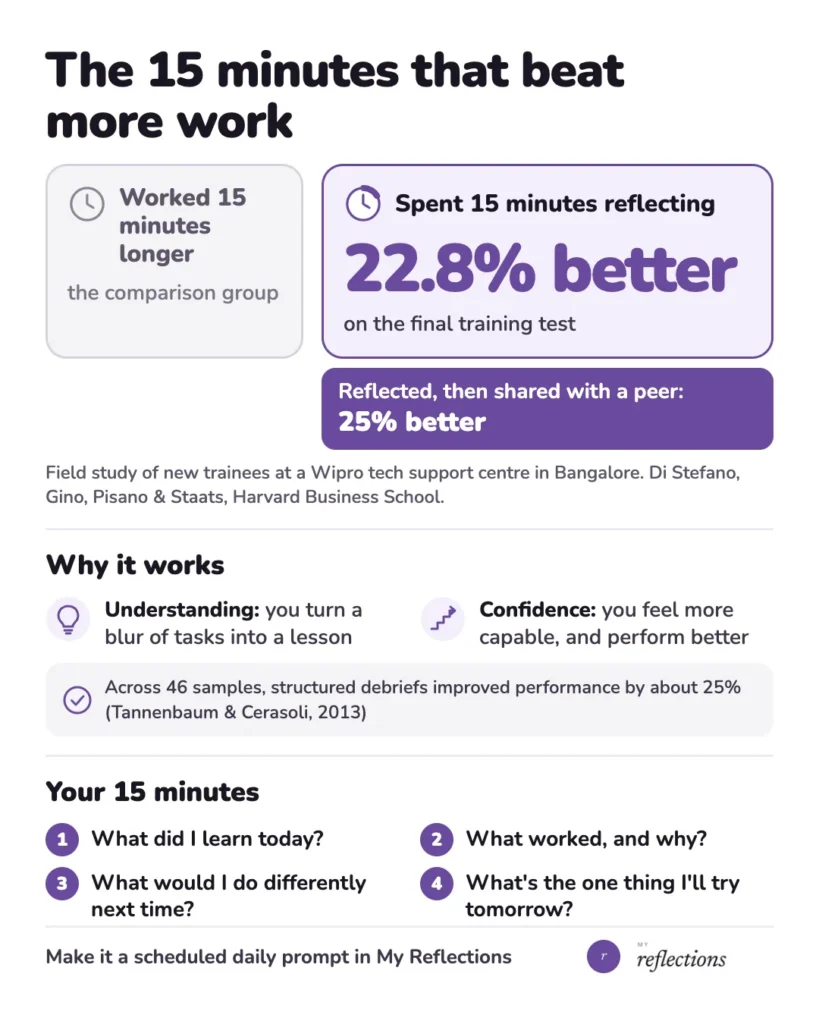
Why it works
The authors’ later version of the paper, “Making Experience Count: The Role of Reflection in Individual Learning” (2016), makes the central argument clear. Once you have built up some experience with a task, the benefit of more experience is smaller than the benefit of deliberately articulating and codifying what you’ve already done.
They point to two reasons:
- Understanding. Writing it down forces you to turn a blur of tasks into a lesson: what worked, what didn’t, what you’d do differently. You understand the task better.
- Confidence. In the team’s lab studies, people who reflected reported feeling more capable and competent, and that sense of self-efficacy helped explain why they performed better. As Gino said, “When we stop, reflect, and think about learning, we feel a greater sense of self-efficacy. We’re more motivated and we perform better afterward.”
It isn’t just one study pointing this way. A meta-analysis by Scott Tannenbaum and Christopher Cerasoli (Human Factors, 2013) pooled 46 samples (2,136 people) on debriefs, the structured “what happened and what did we learn” reviews used by the military, aviation and medicine. On average, debriefs improved performance over a control group by about 25% (d = .67), and the effect was similar for individuals and teams. The authors also found that structure and alignment mattered: a focused review beats a vague chat.
There is a catch worth noticing, and it’s a hopeful one. Reflection pays off once you have something to reflect on. You don’t need to be an expert. You need a day.
A 15-minute end-of-day reflection you can try
You don’t need a call centre or a research team. Here’s a simple version, built from what the trainees were asked to do. Set a timer for 15 minutes and write, or say, your answers.
- What did I learn today? One or two lessons, written as if you were explaining them to someone starting tomorrow.
- What worked, and why? Name the action, not just the outcome. “I asked for the brief in writing” beats “the meeting went well”.
- What would I do differently next time? Keep it curious, not critical. You’re writing notes for future you, not a performance review.
- What’s the one thing I’ll try tomorrow? Small and specific.
If you have a colleague, a mentor or a fellow new starter, read them one line. The study found sharing didn’t add much on top of reflecting, but it didn’t hurt either, and it’s a nice way to close the day together.
If you’re early in your career or new to a role, this matters even more. The paper’s argument is about the early part of the learning curve, which is exactly where you are. If you’re a busy manager, the case is the opposite of what your calendar tells you: the last 15 minutes may be worth more as thinking time than as one more email.
How to build the habit in My Reflections
I built My Reflections because I wanted exactly this: a quick, honest record I could learn from without starting a long journal. To be clear, none of these studies tested My Reflections. But here’s how the app’s features map onto what the research describes.
The same 15 minutes every day: scheduled reflections and daily prompts. The trainees reflected at the end of every day, not when they remembered. In My Reflections you can set a reminder for a time and weekdays you choose. With Professional, a scheduled reflection opens a ready-to-finish reflection at that time, and daily journaling prompts can drop a question into a new journal entry on the days you pick. You can add your own questions to the prompt library, so “What did I learn today?” can be the one waiting for you at 4:45pm.
Articulate it: text, dictation or video. The study’s active ingredient was putting the lesson into words. Type a short note, use Dictate on iPhone, or, new in version 3.0.2, record a video reflection. Your words are turned into text as you speak, so you get the clip and a transcript you can scan later.
See your own progress: watch it back. The researchers linked the benefit to self-efficacy, the feeling that you’re capable. There’s something powerful about watching last month’s version of you wrestle with a problem you now handle easily. Video reflections stay with your other reflections, ready to watch on your phone or in the web app.

Name the action, then rate it. Every reflection starts with a type (a meeting, a task, a journal or a daily check-in), a 1 to 10 rating and a short note. Optional highlights and lowlights give you the sharper “what worked, what didn’t” record that structured debriefs rely on.

Reflect, then share: groups. For the sharing version, groups are invite-only rooms for shared prompts and reports. Joining a group is free; creating one is part of Professional. A mentor or team lead can post a prompt, and each person completes their own reflection. In a closed group, only the owner sees members’ answers, so new starters can be honest.
Look back: Insights and deep dives. Insights show patterns across your reflections, and a deep dive is a dated report over whatever stretch you choose, with each figure opening the notes behind it. If Reflection Bot is on, it adds a tone score to each saved reflection. It doesn’t chat or advise, and you can switch it off.
Core reflections, reminders, Insights and joining groups are free. Video reflections, scheduled reflections, daily journaling prompts and creating groups are part of Professional (USD $2.99 a month after a 7-day free trial).
The honest caveats
This is a striking result, so it deserves careful handling.
- It’s one field experiment, in one setting. These were new trainees at one company, learning one job, measured on one training test. Your role, your day and your results will be different.
- It’s a working paper. It has been widely cited, but read it as strong evidence from a specific study, not a law of nature.
- The percentages aren’t a promise. Nobody should expect to score 22.8% higher at anything because they journal. The debrief meta-analysis gives broader support that structured reflection helps performance on average, across many settings.
- You need some experience first. The authors argue reflection pays off once you’ve done enough to reflect on.
FAQ
Does it have to be exactly 15 minutes?
No. Fifteen minutes is what the trainees did. The principle is a regular, deliberate pause to put lessons into words. Start with what you’ll actually keep doing.
Does it have to be written?
The study used writing. Saying your lessons out loud or recording them is a reasonable way to articulate them too, but that particular format wasn’t what was tested.
Is sharing with a colleague worth it?
In this study, sharing performed about the same as reflecting alone. Do it if it helps you stay consistent or builds trust in your team; skip it if it gets in the way.
What if I miss a day?
Pick it up the next day. The point is the habit over weeks, not a perfect streak.
Try it tonight
Before you answer that last email today, stop. Set 15 minutes aside and ask yourself what you learned. If you’d like somewhere to keep the answers, My Reflections is on the App Store, Google Play and the web, and the core reflections are free. Then, in a month, look back and see how far you’ve come.
References
- Di Stefano, G., Gino, F., Pisano, G. P., & Staats, B. R. (2014). Learning by Thinking: How Reflection Aids Performance. Harvard Business School Working Paper 14-093. Summary: https://www.library.hbs.edu/working-knowledge/reflecting-on-work-improves-job-performance
- Di Stefano, G., Gino, F., Pisano, G. P., & Staats, B. R. (2016). Making Experience Count: The Role of Reflection in Individual Learning. https://ebslgwp.hhs.se/heccah/abs/heccah1181.htm
- Tannenbaum, S. I., & Cerasoli, C. P. (2013). Do team and individual debriefs enhance performance? A meta-analysis. Human Factors, 55(1), 231-245. https://doi.org/10.1177/0018720812448394
Try the two-minute version tonight.
Reflecting is free, on iPhone, Android and the web. Professional has a 7-day trial.
Get the appKeep reading
Reflection practice
Ask It Again: 10 Self Reflection Questions for Growth
Ten self reflection questions for growth from the My Reflections prompt library, and how scheduled prompts, revisits and video help you keep asking them.

Reflection practice
Group Reflection Questions That Lead to Decisions
Group reflection questions only help when the answers lead to a decision. Use this three-stage structure and question set to turn team reflection into action.