
Most people who want to reflect more do not have a motivation problem. They have a design problem. They aim for a long journal session, miss two nights, feel behind, and stop. The habit was never built to survive a bad week.
The fix is unglamorous. Make the reflection smaller than feels satisfying, attach it to something that already happens, and give yourself a way to read it back later. Here is how to build a reflection habit that holds up on ordinary Tuesdays, not just motivated Sundays.
Why reflection habits fall apart
Reflection is the process of taking time to think about our experiences, understand our actions, and learn from both our successes and challenges. That definition is broad, and the breadth is part of the problem. If the habit is simply “be more reflective”, there is no finish line, no way to know whether you did it, and nothing specific to repeat tomorrow.
Reflection also tends to get bundled with journaling and meditation, and plenty of people have a love-hate relationship with both. They know it is good for them, they sometimes even enjoy it, and they still do not do it consistently. The missing ingredient is usually structure.
A habit must also survive the days you are tired, busy or emotionally flat. Anything that requires a particular mood breaks the first time you have a hard week.
Start small enough that skipping feels silly
Published journaling guidance is blunt about this: respect your rhythm and pace, start with just a few lines each day, and expand as you feel able. Starting small is not a compromise. It is how the habit earns the right to grow.
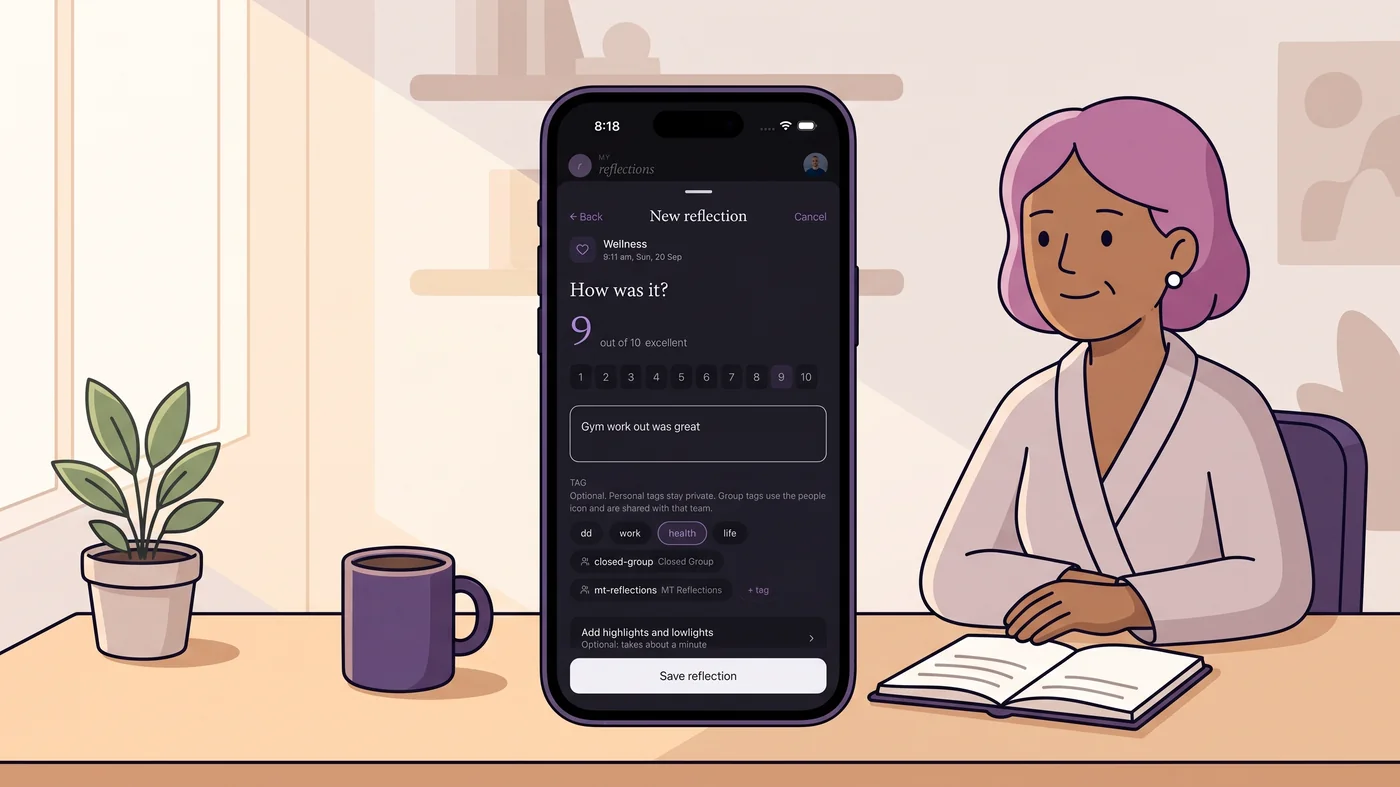
A practical version is a rating plus a short note. One number for how the day went, and a sentence or two about why. My Reflections, a self-reflection app for iPhone and the web, is built around exactly that two-minute format: a rating and a note, stored as a searchable record of decisions and outcomes.
Two minutes is deliberately unambitious. It is also short enough that you can do it in a car park, on a train, or while the kettle boils. The point of the early weeks is repetition, not insight.
Keep the first version boring
For the first fortnight, do not add tags, photos, mood charts or long-form writing. Add one thing at a time, and only once the base version feels automatic. Layered habits collapse from the top down.
Anchor reflection to something you already do

New habits need a trigger that does not depend on remembering. Attach the two minutes to a fixed moment you already repeat daily: the coffee, the end of the commute, closing the laptop, or brushing your teeth. The trigger does the remembering so you do not have to.
Choosing the same time each day also creates a fair comparison over weeks. If notes always happen in the evening, changes in tone and content mean something. If they happen at random, you are reading noise.
What to actually reflect on
The blank page is the second most common reason people quit. A small, rotating set of prompts solves it. These are drawn from published reflective practice tools rather than invented on the spot.
| Prompt or practice | Source | What it is good for |
|---|---|---|
| Three-Minute Body Scan | Daily reflection practice list, Ahead App Blog | Noticing physical state before analysing the day |
| Emotion Labeling | Ahead App Blog | Naming the feeling so it stops steering the note |
| Values Compass Check | Ahead App Blog | Testing whether the day matched what you say matters |
| Strength Spotlight | Ahead App Blog | Redirecting attention to what worked and why |
| Growth-Oriented Questions | Ahead App Blog | Turning an event into a next step |
| START column prompts, including what you can welcome in and make time and space for, and what you would like to start prioritising | Saint Belford AU journaling tips | Deciding what deserves more room in the week ahead |
Pick two. Rotate them. A prompt you have answered forty times tells you more than forty prompts answered once.
Respond instead of reacting
One guide to reflective practice makes the case plainly: with regular practice, and through the therapeutic benefits of writing down your thoughts, feelings and reflections, you can respond rather than react. That gap between what happens and what you do next is where the value sits.
Getting there takes a slightly slower pass at your own material. Go back to your list of questions and explore them. Be still. Think. Consider multiple perspectives. Look at the opposite of what you assumed. None of that takes a long time, but none of it happens while you are still angry.
Reflection sits upstream of the other habits
One widely shared post from Shane Parrish puts the case strongly: probably the single most important habit, upstream of all the other ones, is some kind of habit of reflection or review. That framing is useful because it reframes reflection as infrastructure rather than self-indulgence.
Writing for Smashing Magazine in 2018 made a related point: personal reflection enables us to process and make meaning of all of the great (and not so great) learning and working experiences we have had. The experiences are already happening. Reflection is what converts them into something you can use.
Add a review rhythm above the daily note
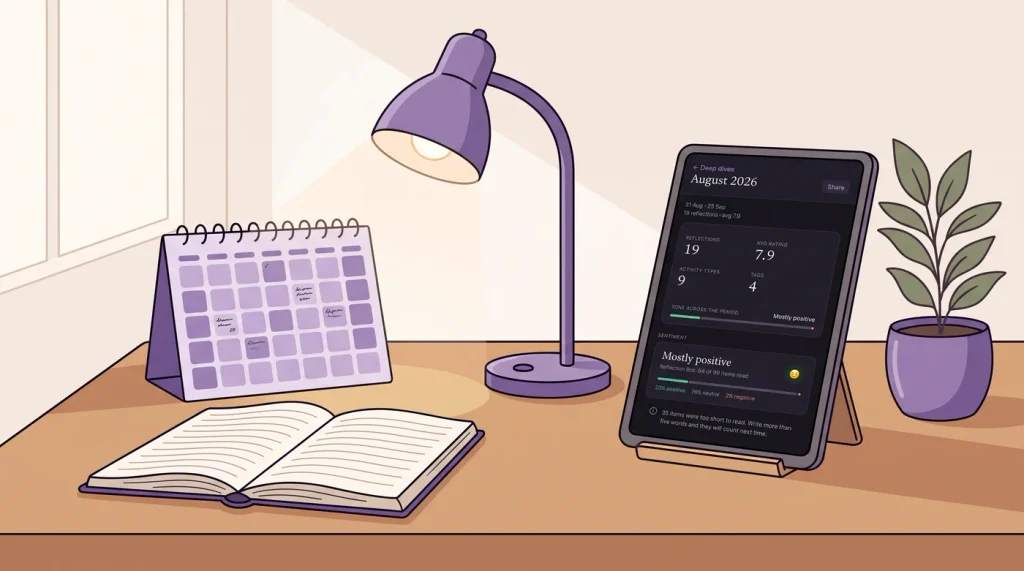
Daily capture records. A regular review interprets. Once the daily habit is stable, set a weekly skim and a longer monthly sitting. My Reflections supports this with deep-dive monthly reports and tone and sentiment analysis, so trends show up without you re-reading every entry.
Tags and goals help here, because they let you ask narrower questions: how did this project month actually go, or how did I feel across the days I exercised. Streaks can be motivating, but treat a broken streak as data rather than a verdict. Reflection is not a performance for a graph.
Watch for the self-criticism spiral
Self-reflection can quickly spiral into self-criticism, and the balance between self awareness, self esteem and self development is delicate. If every entry becomes a list of failures, you will start avoiding the app, the notebook, and the moment of honesty.
Two corrections help. First, use the Strength Spotlight habit and record what you did well, not as a consolation prize but as evidence. Second, notice the difference between a fact and a judgement in your own writing. “I rushed the client call” is a fact you can act on. “I am bad at my job” is a conclusion you cannot.
Published goal setting guidance adds another angle: realise the value of the qualities you take for granted, and affirm what you were unsure of or could not see at the time. Both are reflection tasks, and neither is self-flagellation.
Make it retrievable, or you are only writing
A note you never read again is a diary, not a feedback loop. The loop that changes behaviour runs action, then observation, then reflection, then back to action. That only works if the observation is searchable and the reflection is easy to find.
Practical requirements are modest: full text search, tags you actually use, and a way out of the tool. My Reflections stores notes privately by default, and you can export a CSV of your reflections or delete individual entries from the app. If your reflection is going to contain details about other people, that matters more than features. On iPhone, Capture can queue a note until you are back online, which helps because the moment you want to write is rarely the moment you have signal.
Reflecting with other people
Some of the most useful reflection happens out loud. Coaches and peer circles often run group reflection using shared prompts and reports, and the format can be open, closed, or invitation only. For professionals holding sensitive notes about clients or colleagues, private-by-default storage and export are the features that make group work possible at all. Paid plans add group features, schedules and webhooks alongside the core reflection tools.
A simple week that holds up
- Every day: one rating, one short note, same trigger each time.
- Once a week: skim the last seven entries and write one sentence about what you notice.
- Once a month: read the month as a whole and set one adjustment, not five.
- Every few months: swap in a different prompt so the questions stay alive.
That is the whole system. Small enough to keep, structured enough to learn from, and built to survive the weeks when you would rather not think about it.
Frequently Asked Questions
How long does it take to build a reflection habit?
There is no fixed timeline, and anyone quoting one is guessing. What the published guidance does suggest is respecting your own rhythm and pace, starting with just a few lines each day, and expanding gradually as it feels natural. Most people find the two-minute version easier to protect than a long session, because it fits inside an already busy day.
What if I miss a day or a week?
Missing a day is not failure, it is a normal part of an uneven schedule. The habit only breaks when one missed entry becomes a reason to stop. Pick the trigger again the next day, write a single line about why the gap happened, and carry on. A gap you have written about is still useful data.
Should I reflect on paper or in an app?
Either works, and the honest answer is the one you will actually open. Paper is quiet and unedited. An app makes notes searchable, taggable and easy to review over months, which matters if you want to spot patterns rather than just record days. Some people use both, writing quickly and capturing the useful part digitally.
How do I stop reflection turning into self-criticism?
Watch the balance between self awareness, self esteem and self development. Use prompts that include what worked, not only what went wrong, and separate factual observations from conclusions about your character. If a session leaves you flat every time, shorten it. Reflection should make the next action clearer, not make you feel smaller.
How many reflection questions should I use?
Two is usually enough. A small rotating set keeps the notes comparable over time, while a long list encourages skimming and vague answers. Published practice lists offer options such as a body scan, emotion labelling, a values check, a strength spotlight and growth-oriented questions. Choose two, use them for a month, then swap.
Try the two-minute version tonight.
Reflecting is free, on iPhone, Android and the web. Professional has a 7-day trial.
Get the appKeep reading

Reflection practice
Offline Reflection Apps: Capturing a Note When There Is No Signal
Offline reflection apps differ: device-only vs offline-first with sync. What to test before you trust a year of notes with no signal.
Reflection practice
Guided Self Reflection Prompts That Still Work After a Month
Guided self reflection prompts that stay useful after a month: daily loops, four-week arcs, and how to keep journaling going without burnout.