
Week one with a new prompt list feels like finding a door in a wall. Week four feels like reading the same shopping list. Nothing about the prompts changed, which is exactly the problem: a prompt is only useful while it still has something left to pull out of you.
Guided self reflection prompts last when they attach themselves to something that keeps moving, such as your decisions, your energy and the distance between what you planned and what you actually did. Prompts that ask you to describe a fixed identity run dry quickly. Prompts that ask what happened, and what you made of it, refill themselves.
Why Most Prompt Lists Stop Working by Week Three
Long lists of journal prompts are usually written for one good sitting. That is a perfectly reasonable thing to write. The trouble starts when you try to reuse the list daily and discover that half of it was never designed for repetition.
Big identity prompts are the clearest example. Questions like what a meaningful life looks like to me, or when I feel most like myself, are genuinely worth asking. They are also too large to answer more than two or three times a year. Ask them weekly and you start writing the same paragraphs in slightly different sentences, then quietly skip the session because you already know what you will say.
The second problem is abstraction. A prompt that asks for a feeling gives you a feeling. A prompt that asks about a specific day, such as what your happiest moment today was or which challenge you overcame, is anchored to evidence, so the answer has to change when the day changes.
The third problem is memory. If you cannot see what you wrote three weeks ago, you cannot tell whether you are growing or simply circling. A prompt with no history behind it is a prompt you will eventually stop trusting.
The Two-Minute Rule for Prompts That Survive
Time is the hidden variable in every reflection habit. A prompt that takes twenty minutes is a prompt you will do twice. A prompt that takes two minutes is a prompt you can do on a bad day, and the bad days are where the useful material lives.
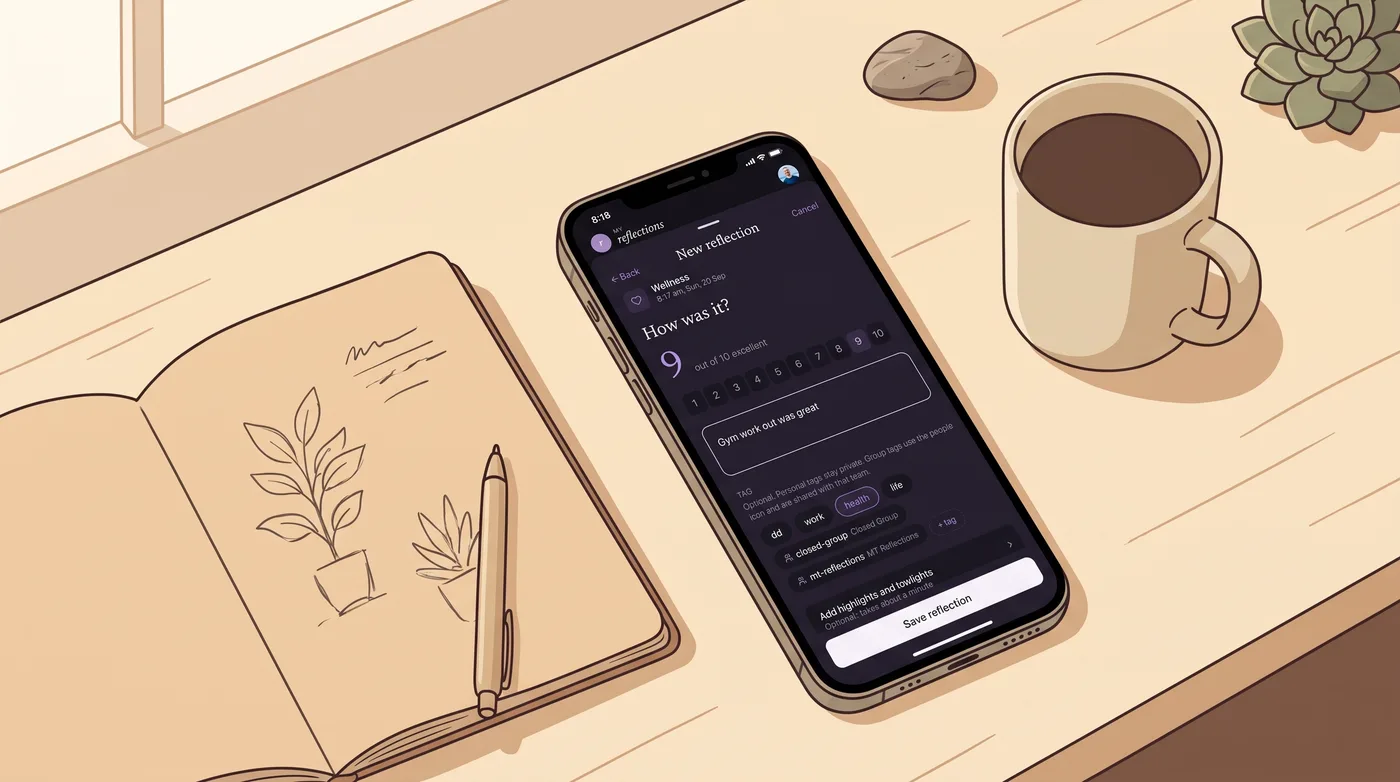
My Reflections was built around exactly that constraint: a rating plus a short note, captured in about two minutes on iPhone and at go.myreflections.app. The rating does most of the heavy lifting. It gives every note a number attached to it, so a month of short answers turns into a line you can actually read, rather than a pile of paragraphs you never revisit..

Daily Prompts Worth Repeating
Daily prompts should be small, concrete and answerable in a sentence or two. These four hold up because the answer is different every time you sit down.
- What was the best part of today?
- What are the top three things I am grateful for today?
- What was one challenge I overcame today, and how did I get through it?
- Rate the day out of ten, then write one sentence explaining the rating.
That last one is the quiet workhorse. It forces a judgement first and an explanation second, which is the reverse of how most people journal. Instead of writing until a conclusion appears, you commit to a number and then justify it. Over a month, the explanations become far more honest than the entries you would write without a rating attached.
Keeping the Daily Set to Three or Fewer
Three prompts is a ceiling, not a target. Two is usually better. If you catch yourself adding a fourth question because the third one feels incomplete, you are designing a worksheet, not a habit. Rotate the daily prompts weekly instead of stacking them, and keep the rating constant so the record stays comparable.
Weekly Prompts That Do the Heavier Work
Weekly prompts can ask bigger questions because a week of evidence sits behind them. A common structure is a short ritual built around five focused prompts, paired with a review of your goals and calendar for the week ahead.
Prompts that suit a weekly sitting include:
- What do I need to let go of right now?
- Where do I feel most at peace?
- Do I set unrealistic deadlines for my goals, and where did that show up this week?
- What did this week ask of me that I did not expect?
The deadline question is worth keeping in rotation for a whole quarter. It is a pattern question dressed as a planning question, and it tends to produce a different, slightly uncomfortable answer each time.
Monthly Prompts for the Patterns You Cannot See Daily
Monthly prompts trade detail for shape. They work best when you answer them with last month’s notes open in front of you rather than from memory.
Good candidates include questions about a decision you made that changed your life and how it shaped your future self, and a slower exercise where you walk back through each month of the past year and pull out at least one thing that genuinely went well. That second one is surprisingly hard, which is precisely why it earns its place.
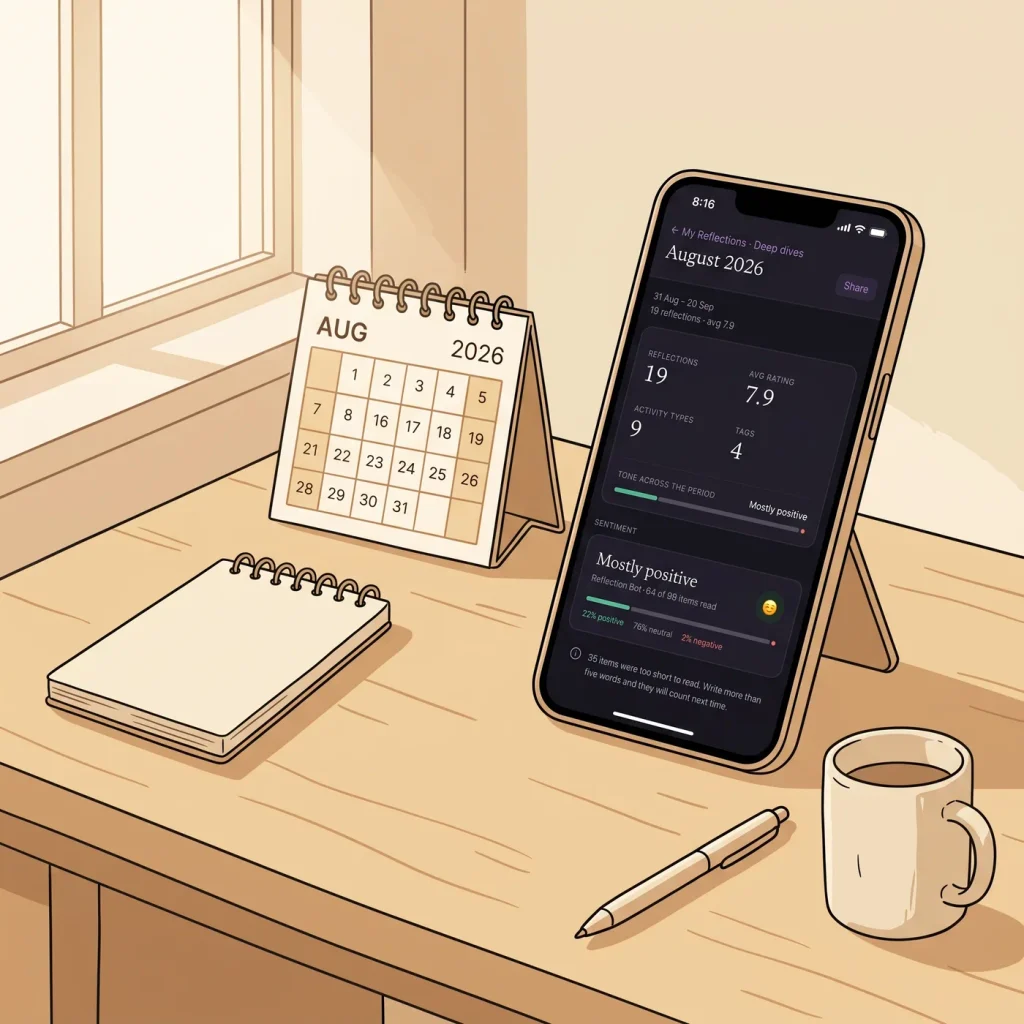
Monthly is also where a rating history starts paying rent. Deep-dive monthly reports, tone and sentiment analysis, tags and goals turn a stack of two-minute entries into something closer to a pattern you can argue with.
A Four-Week Rotation You Can Actually Keep
One way to survive the four-week wall is to change the lens each week instead of changing the prompts every day. The routine stays identical. Only the focus moves.
| Week | Focus | Prompt to try |
|---|---|---|
| One | Orientation | What do I need to let go of right now? |
| Two | Energy | Where do I feel most at peace? |
| Three | Evidence | What are three things I am proud of myself for? |
| Four | Direction | What is one decision I made this month, and how has it shaped what comes next? |
After week four, run the cycle again. By the second pass you will notice which week produced the most useful writing, and that is information about you, not about the prompts.
Swap the Specifics, Keep the Shape
A prompt can be rewritten without being replaced. Where do I feel most at peace becomes where did I feel most at peace this week. What am I most grateful for today becomes what am I most grateful for this month. The frame stays stable so your records stay comparable, while the timeframe shifts so the answer has to be new.
Three Signs a Prompt Has Gone Stale
- You can predict your answer before you finish reading the question.
- Your entries get shorter over several days in a row, and not because you are being concise.
- You skip the session rather than answer it, which usually means the prompt is asking something you have already settled.
When any of those show up, do not throw the prompt away. Give it a different entry point: a timeframe change, a comparison against last month, or a rating attached to it. A prompt that has gone stale is often a prompt that has done its job.

Recording the Answers So They Keep Working
Prompts only stay alive if the answers remain readable later. A notebook works until it does not, and the moment it stops working is usually the moment you want to compare this month with three months ago and cannot find the page.
Whatever you use, the practical requirements are the same: quick to capture, easy to search, and yours to take with you. My Reflections keeps notes private by default, does not use them for advertising, and offers a one-file export. There are free and paid tiers, and the Professional tier is $2.99 per month with a 7-day trial. It supports groups for coaching or team reflection without implying per-seat pricing.
Start with three prompts, one rating, and a rotation you can repeat without thinking. The prompts will keep working as long as the questions stay smaller than the habit holding them up.
Frequently Asked Questions
How many guided self reflection prompts should I keep in rotation?
Two or three daily prompts is plenty, plus one larger question for a weekly sitting and one for the end of the month. A short list you actually finish beats a long list you abandon. Once a prompt starts producing predictable answers, swap the timeframe rather than adding another question to the pile.
Can I use the same prompt every day?
Yes, provided the prompt points at something that changes. What was the best part of today or what are you grateful for today will give you a different answer tomorrow. A question about your identity or your life direction will not. Save those for a weekly or monthly session where you have enough new evidence to say something you have not already said.
What should I do when a prompt stops working?
Change the frame before you abandon it. Narrow the timeframe, attach a rating, or answer it while reading an older entry. Most prompts go stale because the question has been settled, not because the question is bad. If a second pass with a new frame still produces nothing, retire it and move on without guilt.
Do I need an app to reflect with prompts?
No. Paper works, and plenty of people keep it for years. An app earns its place when you want to search old entries, compare ratings over time, or share reflections with a group or coach. Choose whichever format you will actually open on a difficult day, because that is the day the habit is decided.
Try the two-minute version tonight.
Reflecting is free, on iPhone, Android and the web. Professional has a 7-day trial.
Get the appKeep reading

Reflection practice
Daily Self Reflection App: What to Check Before You Install
Before installing a daily self reflection app, check the daily loop, privacy, export, pricing and missed-day streak behaviour.
Reflection practice
Self Reflection App: How to Choose One You Will Still Open in 2026
Not every self reflection app earns a second week. Judge prompts, privacy, export and friction before you download one you will still open in 2026.