

Although the literature and research strongly link the effort put into reflection with improved personal and professional development, it is still often neglected, the question is why?
In this article, I will explore some reasons why people may not be actively reflecting on their own performance: let’s call them excuses!
“I’m too busy”, “I don’t have the time”, “I’m booked back to back”
This is probably the most common excuse out there; there is often a direct association between how full someone’s calendar is and how successful they perceive themselves. I could not count the number of times that I have heard people stating that they are booked “back-to-back-to-back all day” like it is not a reflection of a poorly planned day.
“I don’t understand the process”
This is only an excuse in the sense that they have not taken the time to understand and learn how to effectively reflect. Let me be straight, reflection is not particularly hard to do, in fact, I would argue that it is actually quite simple.
Many of us reflect in different ways, sometimes without even realising it, but taking the time to develop and implement reflective habits takes a level of self-awareness and humility that some people just do not have.
“I prefer action than reflection”
In truth, this is more of a justification than an excuse from somebody who does not appreciate that reflection is all about being able to act and make better decisions.
Action is always necessary of course, but taking time to ensure that your actions accomplished the expected results leans on the spiral of knowledge principles.
Shhhh “I don’t like the results”
The final excuse is one that is unlikely to spoken, but it is the only explanation as to why people who understand the benefits of reflection but still fail to do so, and that is that on some level they do not like what their own reflection tells them about themself.
This is where we start to see the effect of ego on our reflection habits. Accepting that there is something to gain from reflection suggests that you are not making the correct decisions; it relies on a level of self-awareness and humility that is sometimes lacking in people with low levels of personal or professional maturity.
If any of these excuses ring true for you, don’t hesitate to reach out to My Reflections to ask them how to remove these excuses from your own habits!
How does My Reflections help you reflect effectively?
My Reflections supports the development of reflection habits so that you can take control of your personal & professional development, and make the most out of your experiences. Core reflections are free. Professional unlocks photo journals, groups you create, and schedules.
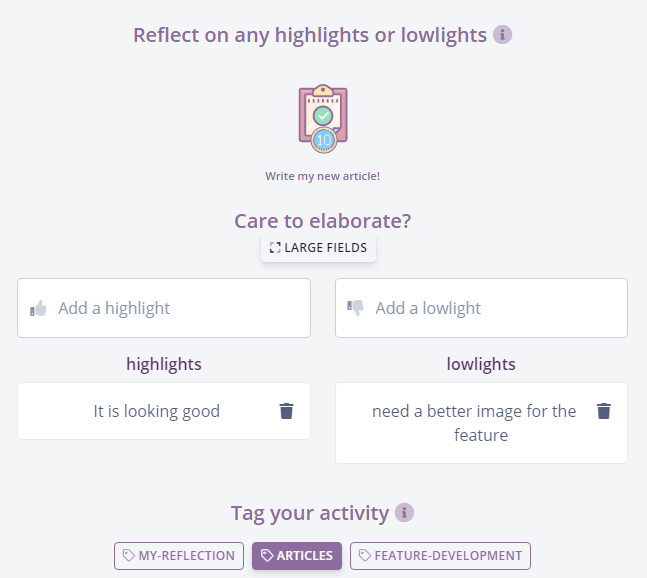
You start your reflection journey by tracking activities throughout the day, rating your performance or feelings towards this activity between 1-10.
As the benefits of reflection increase the closer to the activity, you can provide highlights and lowlights for the activity; giving you a snapshot to trigger emotion and memories for subsequent deeper reflection.
You can also build your own tags to help you categorise and group your activities to suit your own needs and requirements. For example; you may add a task for each project that you’re actively working on; you may categorise your appointments by type, doctor, dentist, etc.
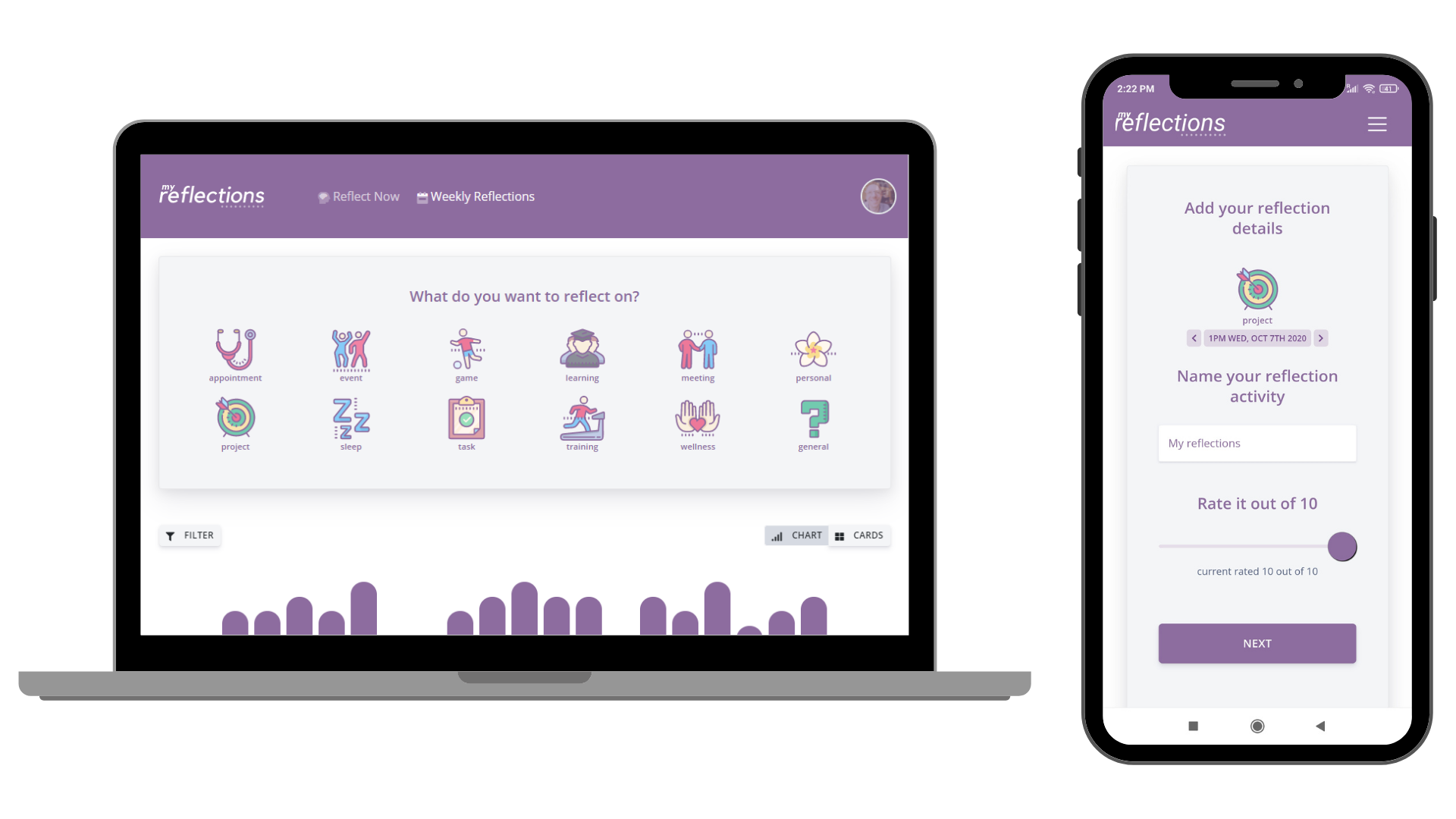
So far, so good! When you are ready to look back, open a deep dive: charts for ratings, activity types and tone, with every figure opening the reflections underneath.
When it helps the conversation, share a single reflection or a deep dive link. Everything else stays private by default.
Try the two-minute version tonight.
Reflecting is free, on iPhone, Android and the web. Professional has a 7-day trial.
Get the appKeep reading

Reflection practice
Two minutes on the plane
Write when the evening is real, not when the network is. Offline queue and sync keep the two-minute habit intact.
Reflection practice
Reading tone across a month of decisions
Sentiment is a mirror on how you wrote the month, not a score to game. Pair it with the reflections underneath.