

Habit tracking and mindfulness sound like they belong together. One builds consistency, the other builds awareness. Put them side by side and you get a practice that actually sticks. Then the streak counter appears, and something goes sideways. A missed Tuesday becomes a red mark, the red mark becomes a story about your character, and the calm practice you started turns into one more thing you are failing at.
That is not a personal weakness. It is a design problem. Habit tracking for mindfulness only works when the tracking serves the practice rather than the other way around.
Why streaks create guilt in the first place
Streaks are a motivational mechanic borrowed from productivity culture. They are excellent at driving repetition and terrible at tolerating real life. Travel, illness, a rough week at work: all of it breaks the chain, and the chain is what you have been told to protect.
Habit research describes habits as following a four-step loop of cue, craving, response and reward. Tracking can reinforce that loop and create positive feedback, which is exactly why it feels so good early on. The trouble is that the feedback most trackers give you is binary. You either did the thing or you did not. A mindfulness practice does not work like that. Some days you sit for twenty minutes and stay scattered the whole time. Other days you take five slow breaths at a traffic light and notice more than you did all week.
What mindful habit tracking actually means
Mindful habit tracking is the intentional practice of observing your behaviours without attaching moral judgement to the outcome. Read that again, because the second half is the part most trackers ignore. Observation is the point. Judgement is optional, and mostly it is noise.
In practice that changes what you record and why. You are not collecting proof that you are a good person. You are collecting data about what your days actually look like, so you can make small adjustments based on evidence rather than vibes.
Tracking to assess, not to grade
Habit tracking is a useful way to assess the practices you need to reinforce and the things you need to change in your life. That framing keeps the attention on adjustment. A rough fortnight is not a verdict on your discipline. It is information that something in the routine is not fitting your current reality.
The habit loop, minus the pressure
The cue, craving, response, reward loop still applies. For mindfulness, the cue might be the kettle going on. The craving is a small preference for a calmer morning. The response is the practice itself. The reward is what you notice afterwards. Tracking makes the loop visible so you can see where it breaks. If you keep skipping the evening session, the useful question is not why you are lazy. It is what the cue is competing with at that hour.
Start smaller than feels impressive
The most reliable way to avoid streak guilt is to set a bar low enough that failure becomes boring. Five minutes counts. So does one minute of noticing your breath before you open your laptop.
Short formats exist for a reason. A five-minute daily practice that survives a chaotic week beats a thirty-minute one that collapses in eleven days, and the collapse is usually what starts the shame spiral. Structured short programs can help when you want something guided rather than open-ended. A ten-minute morning and evening format with habit tracking attached is one example that shows up in template and app libraries.
Design the tracking so a missed day is survivable
Before you commit to a tracker, decide what happens on the bad day. Write the rule down. Ambiguity is where guilt grows.

- Missing one day means nothing. Resume the next day without comment.
- Missing a week is a signal to shrink the practice, not to abandon it.
- A partial practice counts. Sitting for three minutes instead of ten is still the habit.
- Never let the tracker be the only record. The notes matter more than the ticks.
That last point does a lot of work. A tracker that stores only a checkmark gives you almost nothing to reflect on. A record that holds a rating and a short note gives you something you can read back in a month and learn from.
Use a rating plus a note instead of a binary tick
The most common tracking format is yes or no. It is easy, and it is also the format most likely to produce guilt, because there is no middle ground. A rating scale with a short written note behaves differently.

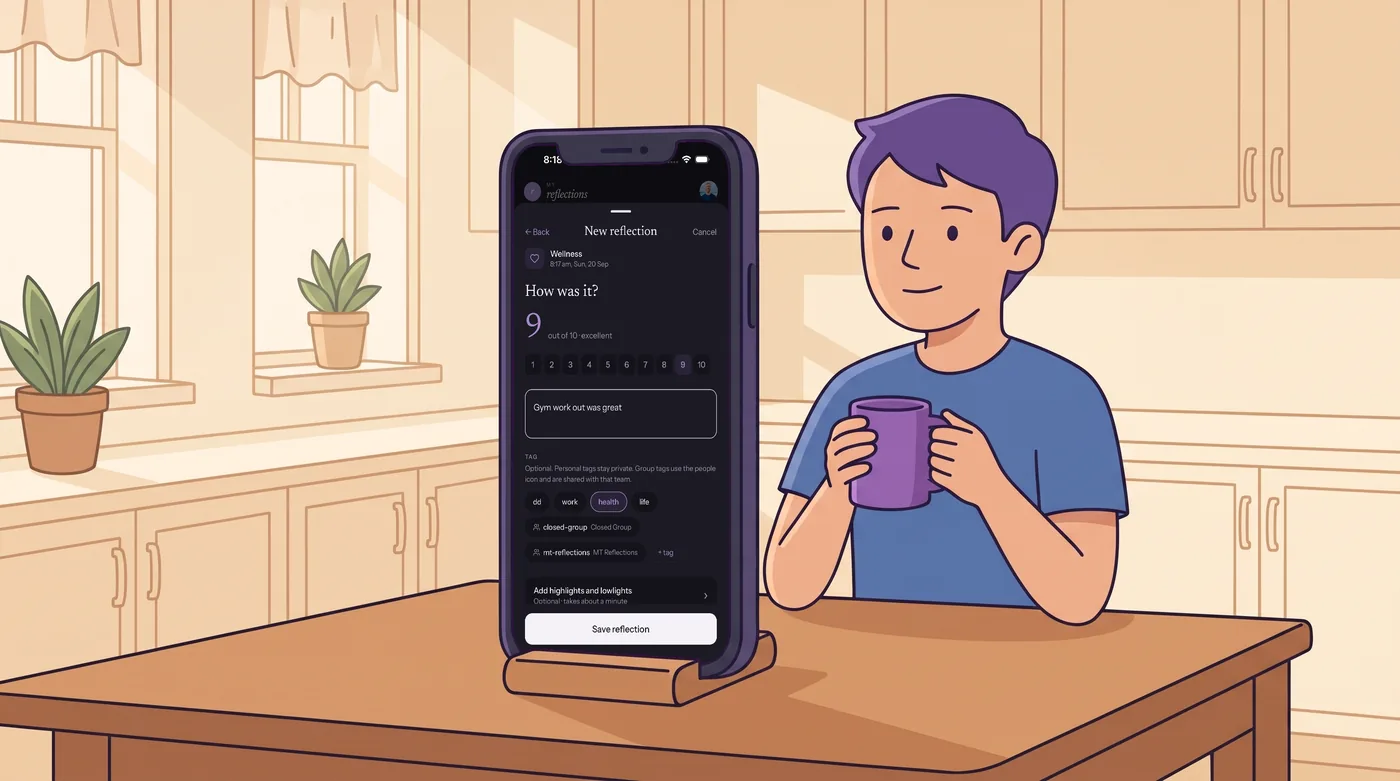
You might rate the session from one to five, then add a sentence: slept badly, mind busy, still sat. Now the low rating is context rather than failure. Over a few weeks you start to see patterns you would never spot in a grid of ticks. Your practice is steadier on days you walk first. It falls apart on days you check email before breakfast. The note is where the insight lives, and the rating makes those notes comparable over time. This is the approach My Reflections takes, built around a two-minute daily habit of a rating plus a note, with an action, observation, reflection loop that carries across iOS, Android and the web.
Keep the review separate from the practice
Daily tracking and weekly review are two different activities and they should stay that way. Checking a box takes seconds. Reviewing takes ten minutes and a bit of honesty.
| Timeframe | What you do | What you are looking for |
|---|---|---|
| Daily | Rate the practice, add one sentence | Honest observation, nothing else |
| Weekly | Read back over your notes | Patterns in when the practice holds or slips |
| Monthly | Adjust one thing only | Whether the cue, the time or the length needs changing |
| When it breaks | Shrink the practice, then resume | A version small enough to survive a bad week |
One adjustment per month is plenty. Changing three things at once tells you nothing about which one helped.
Choose the format that suits your brain
Paper works well for some people. A wall calendar or a small notebook keeps the practice visible and stays out of your phone, which matters if your phone is where your attention goes to die. Digital trackers have the advantage of search, reminders and a history you will not lose in a house move.
Trackers generally aim to help people build consistency and long-term lifestyle changes rather than chase short-term goals, so the features worth caring about are the boring ones. Can you see a month at a glance? Can you sort your habits into areas such as morning, afternoon and evening? Can you search your notes? Can you export your data if you decide to leave? Privacy deserves a mention too, since mindfulness notes can get personal quickly. A tracker that treats your entries as content to be mined is a different product from one that treats them as yours.
When tracking stops helping
There is a point where tracking flips from supportive to compulsive, and it is worth watching for. Warning signs include checking the app more often than practising, feeling dread before opening it, or noticing that you are doing the practice mainly to keep a number intact.
If that happens, take a break from the tracking and keep the practice. Come back with a simpler format. The purpose of habit tracking for mindfulness is to support attention, not to replace it with a scoreboard. The moment the record becomes more important than the moment, the tool has stopped doing its job.
Frequently Asked Questions
What is mindful habit tracking?
It is the practice of observing your behaviours without attaching moral judgement to the outcome. You record what happened rather than whether you were good or bad. That distinction keeps the focus on adjustment instead of self-criticism, and it is what separates a useful record from a scoreboard that quietly makes you feel worse every time you open it.
Do I have to track every day?
No. Daily tracking makes patterns clearer, but forcing a tick on days when nothing happened defeats the purpose. If you miss a day, note it and move on. Missing a whole week is more useful as a prompt to shrink the practice than as evidence about your character. Consistency across a month matters more than an unbroken chain.
How long should I track a mindfulness habit before judging progress?
Give it several weeks before drawing conclusions. Guided programs built around a morning and evening routine are often structured over a set window of around forty days, which is a reasonable period for patterns to appear. Look at the trend across that stretch rather than any single session, and expect the first fortnight to feel uneven while the cue and timing settle.
Can I start again after months away?
Yes, and you should lower the bar when you do. Restart with the smallest version you can imagine keeping, such as a few minutes of quiet attention before you start work. Guilt about the gap is not data. What you learned before the break still counts, and it will make the second attempt easier to shape.
Is a paper tracker better than an app?
It depends on which format you will actually use. Paper keeps the practice away from your phone and stays visible on a wall. Apps offer search, reminders and long-term history, plus export if you want your notes portable. Pick the one you will open on a bad day, because that is the day the tracker earns its place.
Try the two-minute version tonight.
Reflecting is free, on iPhone, Android and the web. Professional has a 7-day trial.
Get the appKeep reading
Reflection practice
Daily Journaling Prompts for People Who Hate Journaling
One-line journaling prompts for people who hate the blank page: a two-minute rating and note, with no streak to protect.

Reflection practice
Daily Reflection Habit: Two Minutes, One Rating, One Note
Build a daily reflection habit in two minutes: one rating, one note, and a searchable record that compounds over ordinary weeks.