

Most reflection advice asks for more than a normal week can carry. Half an hour of journalling, a long list of prompts, a Sunday review that turns into a Sunday guilt session. The version that survives contact with a busy Tuesday is much smaller. Rate the day. Write one note. Stop. Two minutes, on the clock.
That small loop is what My Reflections is built around, on iPhone and the web. It treats reflection as a daily action with two inputs rather than a writing project, and it keeps a searchable record so the habit compounds instead of evaporating.
Why small beats thorough
Jim Knight, writing in ASCD’s Educational Leadership in February 2024, offered a version of this that fits in a sentence: build the reflective habit by writing one sentence at the start or end of each day. One sentence. Not a page, not a chapter.
Leo Babauta, who has written about reflection for years, describes reflecting at least once a day and often several times a day, looking at what he has been doing right and what is not working. Notice the absence of ceremony. He is checking in, repeatedly, in small amounts.
Frequency does work that depth is often credited with. Several short reflections across two weeks beat one long one, because the short ones catch the detail while it is still warm. Memory flattens quickly. An entry written the same evening remembers the tone of the meeting. An entry written three weeks later remembers only the conclusion.
The three parts of the habit
One rating
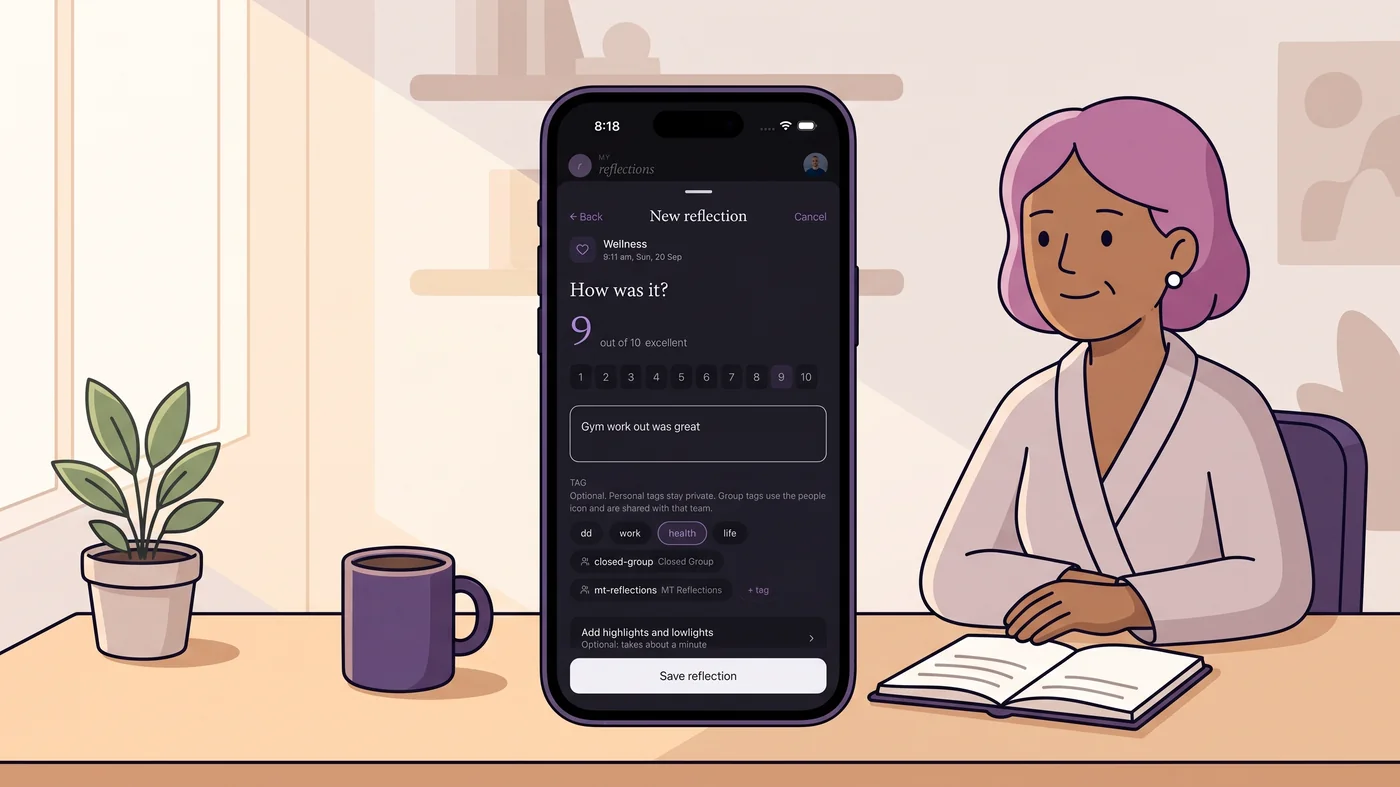
A single number forces a summary that sentences can dodge. You can write around a bad day with careful wording. You cannot really write around a 3 out of 10. The rating is the honest spine of the entry, and it takes about four seconds.
Over a few weeks the numbers form a shape. A run of low ratings is not a verdict on your life, it is a prompt to look closer and ask what the low days have in common. That question is much harder to answer from memory alone.
One note
The note is not a diary entry. It is an annotation on the number. What happened, what you noticed, what you would do differently. One or two sentences is enough, and it is usually better than five paragraphs, because a short note is far more likely to be reread.
A hard two-minute cap
The cap is not a limitation, it is the design. If reflection takes twenty minutes, it gets skipped on the days you most need it. If it takes two, there is almost no excuse. Cheap enough to keep is the whole trick, and a slow breath or two can fill the second minute just as well as more typing.
How a habit like this actually holds
James Clear’s habit loop, quoted by Ed Blunderfield in a piece on forming a daily reflection habit, breaks habit building into four steps: cue, craving, response and reward. Reflection fits that structure neatly once you name the parts.
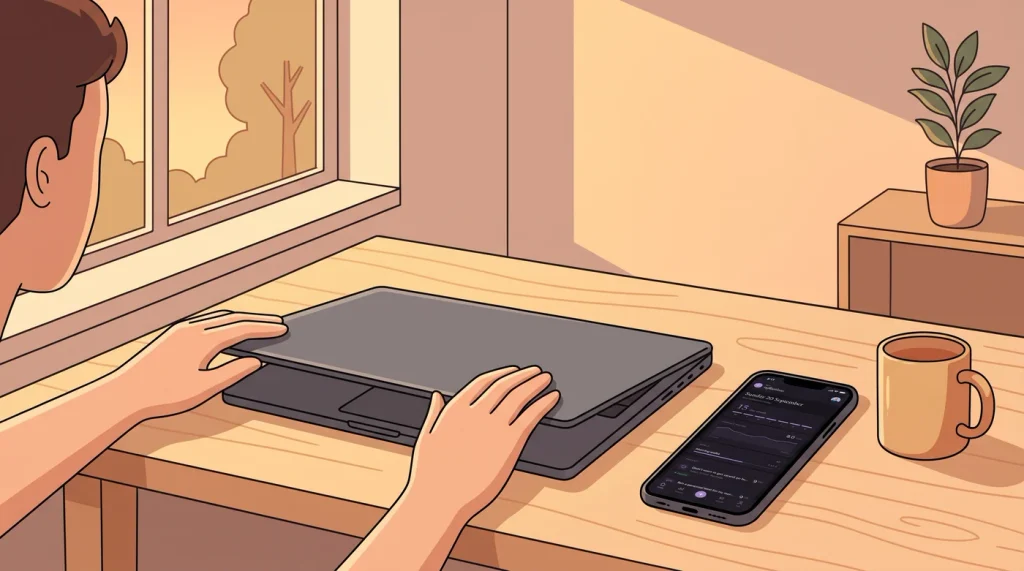
- Cue: a fixed moment. Laptop closed, dishes done, last light off, or the first coffee of the morning.
- Craving: mild curiosity about how the day actually went, as opposed to how it felt in the middle of it.
- Response: the rating, then the note. Two taps and a sentence.
- Reward: the entry itself, plus the small relief of closing the day rather than carrying it.
Friction decides whether any of this survives. If the app sits three screens deep, or the entry needs a title, tags and a mood chart before it saves, the habit dies within a fortnight. The useful setup is the one where a rating and a note can be captured in the time it takes a kettle to boil.
What accumulates over months
The reasons to keep a reflection habit are not exotic. They are the ordinary benefits of paying attention on purpose, and they arrive slowly.
- You learn from mistakes and get past them, instead of reliving them.
- You learn from successes too, which is harder, because wins tend to get spent rather than examined.
- Ideas surface that would otherwise have stayed half-formed.
- You become more useful to other people, because you recognise your own patterns and notice them in others.
- You get happier, in the unglamorous sense of knowing what you actually want from a week.
Leo Babauta lists several of these among his reasons for reflecting daily, and the order is telling. Learning from mistakes comes first. Happiness arrives last, as a by-product rather than a goal.
Noticing is the skill underneath
Reflection is a practice of noticing, and noticing has layers. Ashley Janssen describes the first step as learning to see how you feel across the day, how you feel before and after particular events, your thought process when you make decisions, your automatic reactions to certain situations, and your daily habits.
On autopilot, none of that is visible. The rating and the note train exactly that skill. In month one you notice at 10pm. Later you notice in the meeting, while it is still happening. That shift from after the fact to in the moment is where reflection starts changing decisions rather than just recording them.
A morning version, if evenings do not work
Evening reflection has an obvious advantage: the day is complete. It also has an obvious failure mode, which is that by 9pm you are finished and the entry becomes a chore.
A morning version works just as well. Headspace’s guidance for a short daily reflection makes a good template: find a comfortable position, sitting or standing, close your eyes gently if you can, and take a deep breath in and out. Then rate yesterday and write one line about what matters most today. Pick one slot and keep it, because a habit that alternates between morning and evening based on mood never becomes a habit at all.
Writing a note worth rereading
A note earns its keep if future-you can extract meaning from it in three seconds. Three parts, in any order, are usually enough.
- What happened, in plain terms.
- What it meant, or what you noticed.
- What you will do differently, or want to repeat.
For example: “Hard conversation. I got defensive early, then recovered. Next time, ask before explaining.” That is a complete reflection. It fits in a note field, and it will still make sense in eight months.
Store it where you can search it
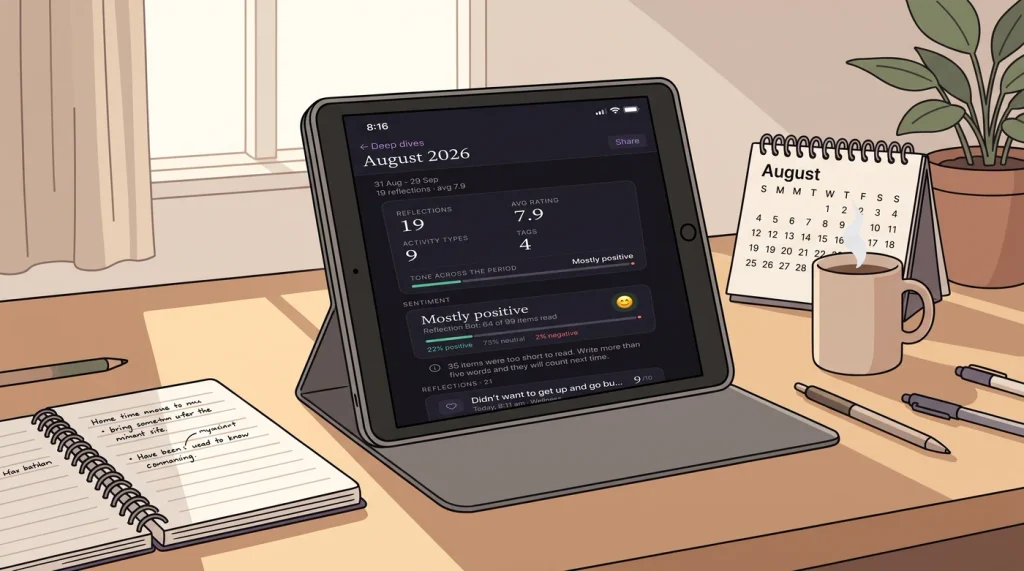
Reflection that never gets reread is only half a practice. The pattern you are looking for is rarely visible in a single entry. It shows up when you can search a word like “deadline” or “conflict” and find eight entries from the past year, each with its rating sitting next to it.
My Reflections keeps that record searchable and analysable, with Insights and deep-dive monthly reports, optional tone and sentiment analysis, tags and goals. Notes are private by default, and you can export a CSV of your reflections or delete individual entries from the app. Free covers the core daily loop. Professional is USD $2.99 a month after a 7-day trial, and adds photo journals, creating and managing groups, scheduled reflections and inbound webhooks for coaches and facilitators who need more than a personal log.
What breaks the habit
- Making the entry too long. Long entries feel productive and get abandoned.
- Waiting for a meaningful day. Ordinary days are where the pattern lives.
- Tying it to a streak that scolds you. A missed day is a missed day, not a moral failure.
- Writing for an audience. Reflection written to impress is not reflection.
- Skipping the note and only rating. A number without context tells you something is off but not what.
Starting tonight
- Choose the moment: last light off, or first coffee. One, not both.
- Put the app where your thumb already goes.
- Rate the day before you write anything. The number first keeps it honest.
- Write one sentence. Stop when the two minutes are up.
- Repeat for seven days, then read back the week. The pattern is usually obvious by then.
That is the whole method. One rating, one note, two minutes, most days. It is unremarkable on any single evening, and it is the reason a year of ordinary days stops being a blur.
Frequently Asked Questions
How long should a daily reflection take?
Two minutes is enough for one rating and one or two sentences, and that short time is what makes the habit survive a busy day. If you want a longer session occasionally, keep it separate from the daily minimum so the two do not blur together. The daily version matters most, because frequency builds the record.
What should I write in a one-sentence reflection?
Write what happened and what you noticed about it, then add what you would do differently if that is clear. Jim Knight’s suggestion of one sentence at the start or end of each day is a good benchmark. The sentence does not need to be elegant. It needs to be specific enough that you still understand it months later.
Is it better to reflect in the morning or at night?
Either works if you keep it consistent. Evening reflection captures the day while the detail is fresh. Morning reflection suits people whose evenings disappear, and it can follow the shape Headspace suggests: a comfortable position, a slow breath in and out, then a short check-in. The habit that survives is the one attached to a moment you already have.
Do I need an app to build a reflection habit?
No. A notebook and a pen will do, and plenty of people start there. What an app adds is structure: a rating field that takes seconds, notes that stay searchable, and reports that surface patterns across months. If you want to compare ratings over a year or search for a recurring situation, a searchable record saves considerable effort.
What if I miss a day?
Pick it up the next day and rate that one. Missing a day does not erase the record or invalidate the practice, and a habit that punishes gaps tends to be abandoned entirely after the first one. If you miss several days in a row, shorten the entry rather than dropping it. Two minutes is deliberately small so this stays possible.
Try the two-minute version tonight.
Reflecting is free, on iPhone, Android and the web. Professional has a 7-day trial.
Get the appKeep reading
Reflection practice
How to Build a Reflection Habit That Sticks in 2026
Learn how to build a reflection habit that survives busy weeks, with small daily prompts, a simple review rhythm, and tools that keep your notes useful.

Reflection practice
Offline Reflection Apps: Capturing a Note When There Is No Signal
Offline reflection apps differ: device-only vs offline-first with sync. What to test before you trust a year of notes with no signal.