

Downloading a self reflection app takes about thirty seconds. Opening it on a Tuesday night six months later is the harder part. Most people who walk away from a reflection habit do not walk away from the idea of reflecting. They walk away from an app that asked too much, gave too little back, or made them feel worse for missing a day.
That gap is not imaginary. In a productivity forum thread about emotional overwhelm, one person described feeling stuck and disconnected from themselves, having already tried journaling and mindfulness, and still failing to stay consistent. A 2026 comparison of seven self reflection tools reached a similar conclusion from the other side of the fence: most apps just store prompts and mood ratings, and only a few actually read your entries back to you.
So the real question is not which app has the nicest prompt library. It is which app you will still open next year. Here is how to judge that before you spend money or move your most private notes into it.
Why most reflection apps get abandoned
Three failure modes cover the majority of abandoned accounts.
- Friction at capture. If opening the app, choosing a prompt, typing a paragraph and saving takes eight minutes, you will do it for a fortnight. A reflection tool has to survive the nights when you are tired, distracted or already in bed.
- No feedback loop. A diary that only receives is a diary. A reflection app should return something: a pattern you did not notice, a theme across a month, a link between how you rated a day and what you actually did in it.
- Guilt mechanics. Streaks that break dramatically, red badges, scolding notifications. These work for a while and then they become one more thing you are failing at, which is the opposite of what reflection is for.
Features that predict you will still open it in 2026
Ignore the marketing screenshots for a moment. The features that matter are structural, not decorative.
The capture step should take about two minutes
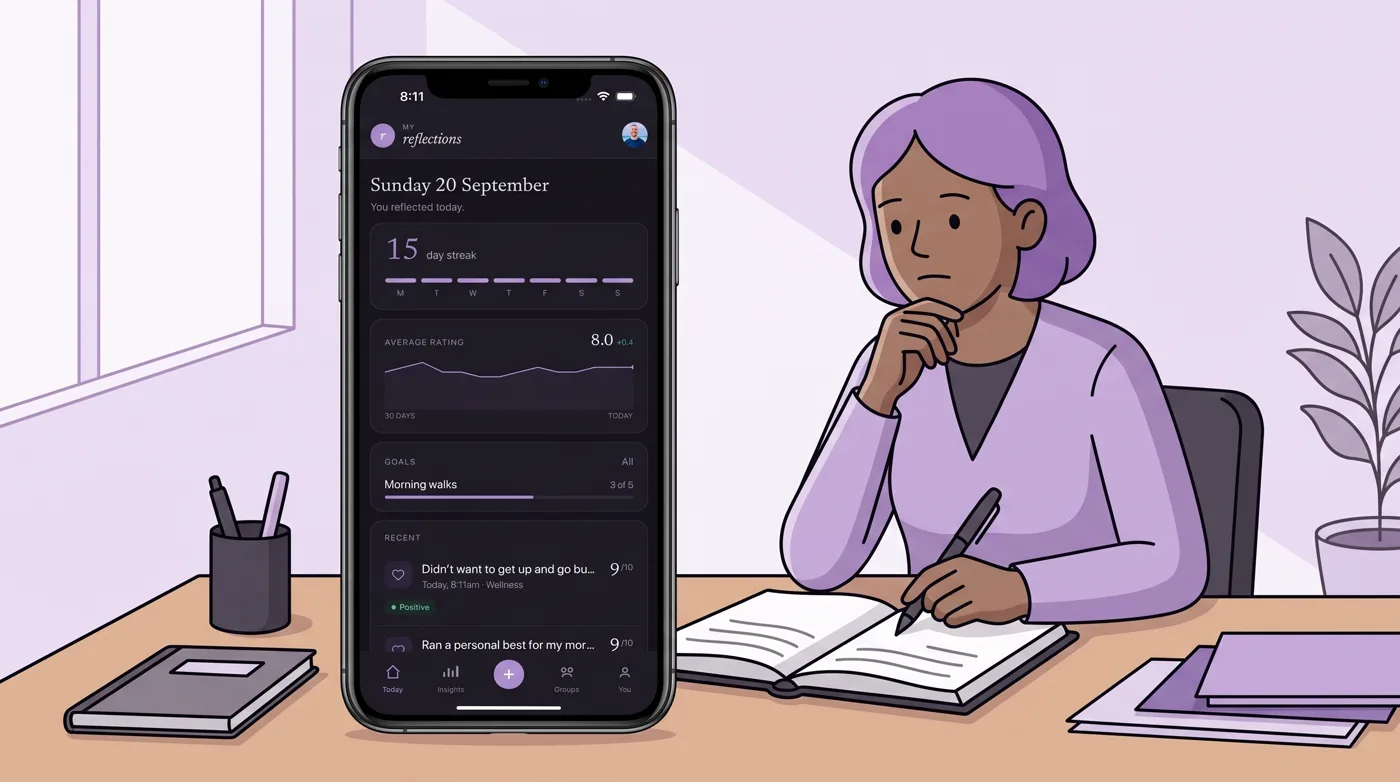
A rating plus a short note is enough to build a useful record. My Reflections is built around exactly that: a quick daily capture that turns into a searchable, analysable history of decisions and outcomes over time. The point is not to write beautifully. The point is to write often enough that patterns become visible. If an app demands a full page before it will save anything, that is a design choice working against you.
The app has to read your entries back to you
This is the dividing line the 2026 comparison highlighted. Apps such as Reflection describe themselves as a journal that listens and talks back, coaching you in real time and turning entries into insights. Reflectly positions its AI journal as a way to work through negative thoughts and increase positivity. Others supply guided journeys instead, such as week-long or fortnight-long sequences built around themes like reflection and reset, or gratitude. Any of these can work. What you want to avoid is a tool that collects your thinking and never returns it.
Your data has to be portable
Ask one blunt question before you start: can I get everything out in a single file? An app that can export your full history and delete it on request is an app you can trust with honest writing about work, relationships and other people. One that traps years of notes in a format you cannot move is a liability. Privacy defaults matter too, particularly if you write about clients, colleagues or family.
The habit has to survive a bad week
Offline-first design matters more than people expect. If the app needs a strong connection to save a note, you will lose entries on trains, in regional areas and in airport queues. Offline capture with sync later is the safer architecture, and it is the difference between a record with gaps and a record you can actually analyse.
How the better known options differ
The market splits into AI coaching journals, mood and self-care trackers, and plain private journals. The table below reflects what each product says about itself in its store listings and site at the time of writing. Ratings and user numbers change, so check the current listing before you decide.
| App | Positioning | What to check |
|---|---|---|
| Reflection | AI-powered journaling and mental wellness coaching, with real-time coaching and insights from entries. Apple listing shows 4.8 stars from 3,000+ reviews; Google Play shows 4.3 stars from 2.36K reviews | How much of the coaching sits behind a subscription |
| Reflectly | AI-driven personal journal and mood tracker aimed at self-care, stress relief and reducing anxiety. Named an App Store Editors’ Choice, with 4.5 stars from 590 ratings | Whether the mood tracking produces patterns you will actually use |
| Mirror | Private space to self-reflect, stating it is trusted by over 250,000 journalers | Export options and what happens to entries if you stop paying |
| Self Reflect | Self-care journey tracking, listed on Google Play | Whether tracking alone gives you enough of a feedback loop |
| My Reflections | Two-minute daily capture of a rating plus a note, building a searchable record of decisions and outcomes, with group and coach options and one-file export | Whether the monthly deep-dive reports match how you like to review |
Questions to ask before you commit
Run these against any candidate app, including the free ones. The answers tell you more than a feature list.
- Can I complete a full entry in under three minutes, including opening the app?
- What does the app show me after thirty entries that I could not have seen myself?
- Can I tag entries and search them later, or am I scrolling through a timeline?
- What happens to my notes if I cancel, and can I export everything in one file?
- Are my notes used for advertising or model training, and is that stated plainly?
- Does it work offline and sync when I reconnect?
- Do the reminders encourage me or nag me?
- If I write about other people, are entries private by default?
A seven day test that settles it
Do not judge a reflection app on day one. Day one is novelty. Judge it on day seven, and use the same plan across every app you are considering.
- Days one and two: capture a rating and one honest sentence. No editing, no polishing.
- Days three and four: add a tag or two, such as a project name, a person, or a type of decision.
- Day five: read back the first four entries and ask what the app has shown you.
- Day six: miss a day on purpose. Watch how the app responds. This is the single most revealing test, because it tells you whether the design supports you or scolds you.
- Day seven: export your data. If the export is missing, awkward or locked, you have your answer.
If the app survives that week without you dreading it, the odds of you still opening it next year improve dramatically.
Free tiers, paid tiers, and what to expect
Most tools in this category offer a free entry point with a paid tier behind it. That is normal and reasonable. What matters is where the paywall sits. A paywall on cosmetic themes is harmless. A paywall on export, on your own history, or on deleting your account is a reason to walk away.
My Reflections follows the common model with free and paid tiers, and the professional tier is listed at $2.99 per month with a 7-day trial and per-seat options for coaches and groups. That structure is worth checking against whatever else you are testing. If a professional plan costs more, ask what you actually get for the difference: group facilitation, shared reports, scheduled prompts, photo journals, or integrations such as webhooks. If the answer is a longer prompt library, it is not worth paying for.
What to do next
Pick two apps, not five. Run the seven day test on both, keeping the same rating scale and the same rough note length so the records are comparable. At the end of the week, keep the one that made reflecting easiest on the worst day, not the one with the most attractive onboarding.
A self reflection app earns its place by being boring in the best way: quick to open, honest to write in, and useful when you read it back. Choose on that basis and you will still be opening it well into 2026.
Frequently Asked Questions
How long should a daily reflection take?
About two minutes is enough to be useful. A rating plus a short note creates a searchable record you can analyse later, which is the whole point. Longer entries are fine when you have something to work through, but they should not be the standard you hold yourself to. Consistency beats depth most weeks.
Is a self reflection app the same as a journal?
Not quite. A journal collects entries. A reflection app is meant to return something: patterns across entries, mood context, or insights drawn from your own words. Some tools blur the line, and several reviews note that many apps still only store prompts and ratings. Check what you get back after a month of use.
Do I need to pay for a good reflection app?
Not necessarily. Many tools, including Reflection, Reflectly and Mirror, offer free downloads with in-app purchases, and My Reflections has free and paid tiers. Decide based on what sits behind the paywall. If export, your own history or account deletion is locked, that is a poor deal regardless of price.
What if I miss a day or a week?
Missing days is normal and should not reset your progress in any meaningful way. What matters is how the app responds. Guilt-driven streaks and scolding notifications are a poor fit for reflective practice. If the design punishes you for absence, that is a reason to choose something else.
Can I export my reflections if I change apps?
You should be able to, and you should test it during a trial rather than after two years of writing. Look for a one-file export and a clear deletion option. If a tool cannot give you your own notes in a portable format, treat that as a warning sign.
Try the two-minute version tonight.
Reflecting is free, on iPhone, Android and the web. Professional has a 7-day trial.
Get the appKeep reading
Reflection practice
Self Reflection App: How to Choose One You Will Still Open in 2026
Not every self reflection app earns a second week. Judge prompts, privacy, export and friction before you download one you will still open in 2026.

Product news
Free to reflect, Professional to lead the room
Unlimited core reflections on Free. Photo journals, groups you create, and schedules on Professional, with a seven-day trial.