
Plenty of people download a reflection app during a hard week and delete it before the month is out. A poster in the r/productivity forum described the pattern exactly: they had tried journaling and some mindfulness, felt stuck and disconnected from themselves, and could not stay consistent. The tool was never the whole problem. The habit was. Choosing well in 2026 means judging an app by whether it survives contact with a normal, busy, unremarkable Tuesday.
Consistency is the only measurement that counts
An app that you open twice and abandon has a value of zero, no matter how elegant its interface or how clever its artificial intelligence. The self-reflection category is crowded with beautiful products that ask a lot and give back little in the first fortnight, which is precisely when most people quit.
That changes how you should evaluate options. Instead of comparing feature lists, compare the cost of showing up. A reflection app should ask for a minute or two, accept whatever you can give on a bad day, and reward you with something worth reading later. If the minimum viable entry is a 600-word essay, you have designed a habit that only works when life is going well. That is backwards, because the weeks you most need to reflect are the weeks you have the least time.
There is a second, quieter test. Does the app give you anything back? A private diary that quietly accumulates entries is a filing cabinet. A reflection tool should return patterns, themes and context you would not have noticed on your own.
What a reflection app is actually doing for you
The 2026 review roundups make the split fairly clear. The Nuju editorial team tested seven self-reflection tools for prompts, mood context, privacy and AI pattern recognition, and their summary of the field was blunt: most self-reflection apps just store prompts and mood ratings. A prompt is useful. A mood rating is useful. Neither one tells you what keeps repeating in your life.
Useful tools tend to do three jobs well:
- Capture. Getting a thought out of your head in under two minutes, including when you have no signal.
- Prompt. Asking something specific enough to produce a real answer, such as what you decided, what you expected, and what actually happened.
- Pattern. Reading your own entries back to you over time so you can see what recurs rather than what you remember.
Apps that only do the first job are diaries. Apps that only do the second are prompt generators. The third job is where the actual self-awareness lives, and it is the one most products skip.
A ten-minute checklist before you download
| What to check | Why it matters | What good looks like |
|---|---|---|
| Time to log an entry | Long entries are the first casualty of a busy week | Under two minutes from unlock to saved |
| Offline capture | Trains, planes and dead zones are prime reflection time | Entries save without signal and sync later |
| Prompt quality | Generic mood checks produce generic answers | Questions about a specific decision or moment |
| Pattern review | Insight comes from repetition, not single entries | A weekly or monthly view that gathers themes |
| Export | You should not lose years of notes to a subscription lapse | A single file you can download and keep |
| Privacy terms | Reflection notes are among the most sensitive writing you will do | Private by default, deletion available, notes not used for advertising |
| Free tier | You need weeks of use before you know if it suits you | A usable free version rather than a hard paywall |
If an app fails the first line of that table, the rest rarely matters. Friction kills habits faster than boredom does.

Friction is the reason apps get deleted
Think about the last app you removed from your phone. It was almost certainly not a lack of interest. It was that opening it felt like work. Reflection is already a slightly uncomfortable act, and every extra tap, login screen and blank text box gives you an excuse to postpone it.
Home-screen widgets, quick ratings and short prompts all exist to reduce that friction. Reflectly, for example, markets a home-screen widget as part of how it keeps people returning. That kind of design decision matters more to your long-term adherence than any feature buried three menus deep.
Streaks: motivation or guilt?
Streaks are the most common retention device in this category, and they cut both ways. A streak can pull you back on a Tuesday night when you would otherwise skip. It can also turn reflection into a chore you complete to protect a number, which is the opposite of the point.
Ask yourself honestly which way you respond to a broken chain. If seeing a streak reset makes you want to quit entirely, a streak-focused app is a poor fit. If it nudges you back without drama, it is fine. What you want is an app that still feels welcoming after you have missed nine days, because you will miss nine days at some point.
Privacy and ownership: the test most people skip
Reflection notes often contain material you would not want indexed, leaked or analysed for advertising. Mirror positions itself as a private space to self-reflect, and Reflection.app describes its app as private, which shows that privacy is now a selling point rather than an afterthought.
Marketing language is not a policy, though. Read the actual terms before you write anything sensitive. Three questions cover most of it: can you export everything in one file, can you delete your account and its data, and are your notes ever used to train models or target advertising? If the answers are vague, treat that as an answer.
Reflection with a coach or a group
Solo reflection is where most people start, but structured programmes are growing. Reflection.app runs journeys such as Reflect and Reset and Gratitude, which ask thought-provoking questions over a week or two rather than leaving you staring at a blank page. That format suits anyone who wants direction rather than an empty box.
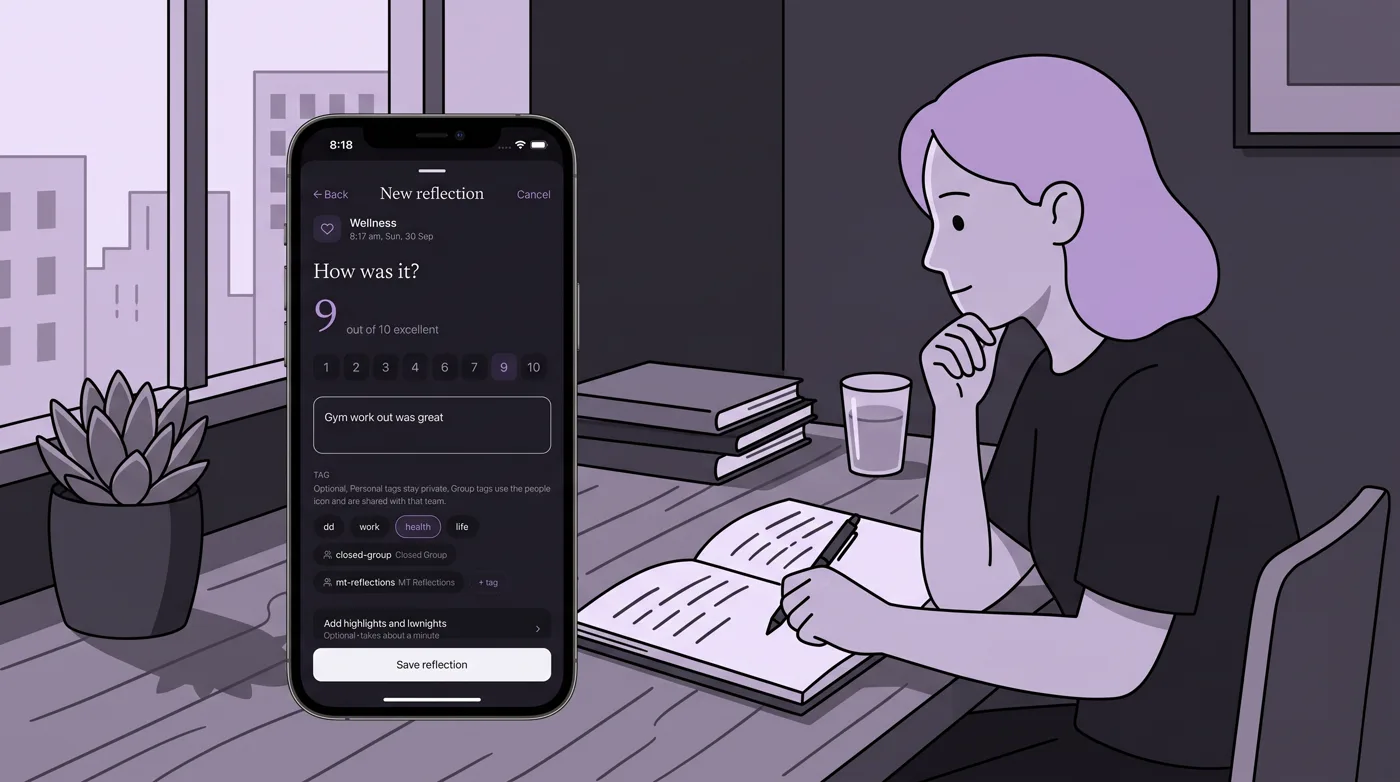
Group reflection adds another layer. If you work with a coach, facilitate a peer circle, or lead a team, look for apps that support open, closed or invited groups, shared reports and some form of facilitation. Reflecting alongside other people tends to expose patterns you would rationalise away on your own, particularly about decisions and their outcomes.
How to test a self reflection app in one week
- Download it on a Sunday and log one entry that day, deliberately short.
- Set a daily reminder for a time you already have a gap, not a time you wish you had one.
- Log something on your worst day of the week. Note how long it took.
- Skip a day on purpose and see how the app responds. Guilt is a warning sign.
- At the end of the week, review your entries and ask whether you learned anything you did not already know.
- Export your data as a test. If you cannot, walk away before you have years invested.
That sequence tells you more than any comparison table, including this one. A tool that passes it after seven days is worth paying for.
Where My Reflections fits
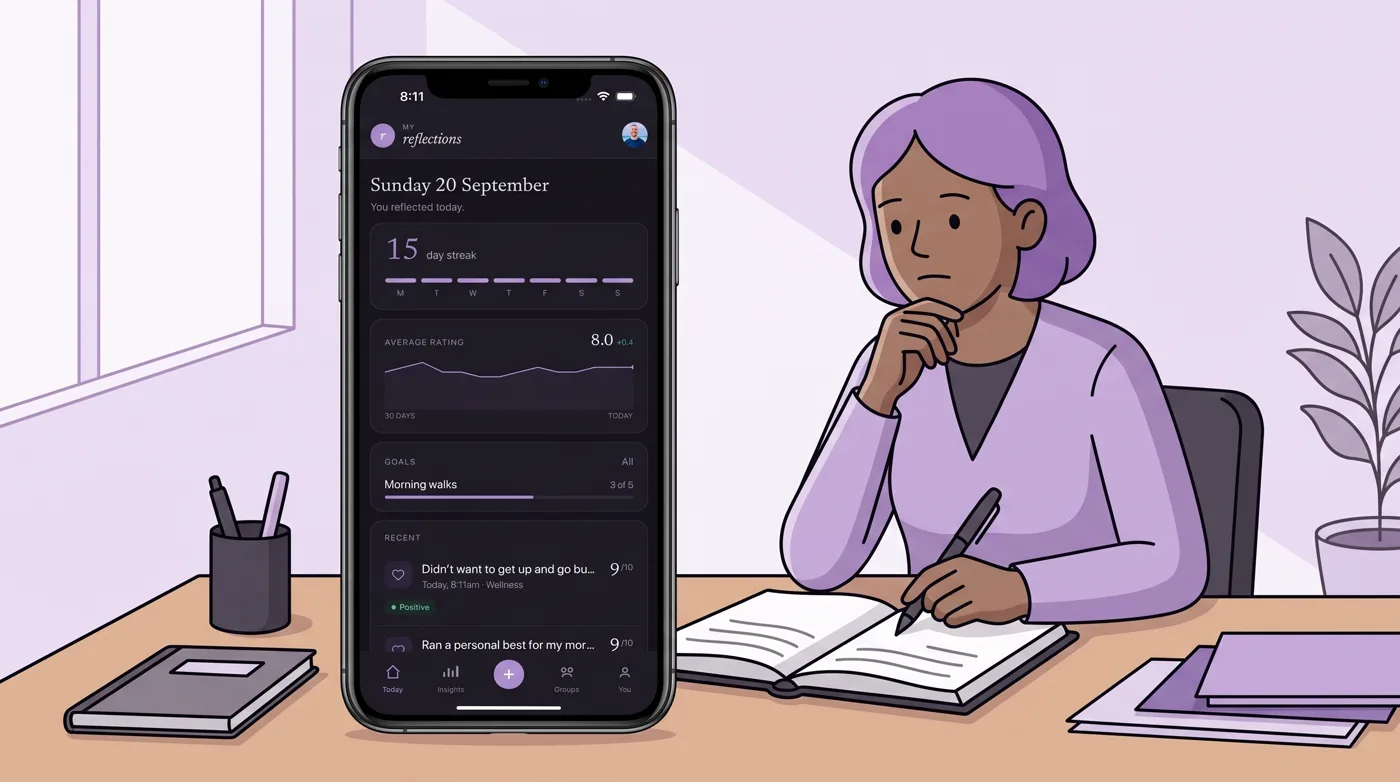
My Reflections was built around a short daily habit: pick a type, rate what happened from 1 to 10, and write a short note. Over time, Insights and deep dives surface patterns across meetings, projects, wellness and daily check-ins. It runs on iPhone, Android and the web. On iPhone, Capture can queue until you are back online; editing and finishing a stub need a connection.
The design choices lean against the patterns described above. Reflections stay private to your account until you share them, and My Reflections does not sell your data or use what you write to advertise to you. You can export a CSV of your reflections from the app or the web, and you can edit or delete individual reflections. Account deletion is still by email to support. Free includes unlimited core reflections, Insights, goals, personal tags, reminders and joining groups you are invited to. Professional is USD $2.99 a month after 7-day trial, and adds photo journals, creating and managing groups, scheduled reflections and inbound webhooks. Whether that suits you depends on the checklist above, so run the seven-day test before you commit to anything.
Frequently Asked Questions
How long should a daily reflection entry take?
A rating plus a short note is enough, and two minutes is a realistic target. Length is a poor measure of quality. A single honest sentence about what you expected and what happened will teach you more over a year than occasional long essays that you abandon after a fortnight. Keep the bar low enough to clear on your worst day.
Are self reflection apps private?
It depends entirely on the product, so check the terms rather than the tagline. Look for private-by-default settings, a way to delete your account and data, a one-file export, and a clear statement that your notes are not used for advertising or model training. If a provider is vague about any of those points, do not treat it as a safe place for sensitive writing.
Do streaks help or hurt a reflection habit?
They help some people and sabotage others. A streak works if a broken chain nudges you gently back. It hurts if losing it makes you quit. Before you commit to a streak-driven app, ask whether you reflect to understand yourself or to protect a number. The second motivation rarely lasts a season.
Can I use a reflection app with a coach or a group?
Yes, and it is increasingly common. Look for apps that support open, closed or invited groups, shared reports and facilitation tools, so a coach or facilitator can guide the process without taking ownership of your notes. Group reflection tends to surface patterns in your decisions that are easy to rationalise away when you are the only person reading.
Is a free reflection app good enough?
Often, yes, at least to start. A free tier lets you test whether the habit sticks before you spend anything. My Reflections Free includes unlimited core reflections, Insights, goals, personal tags, reminders and joining invited groups. Professional is USD $2.99 a month after 7-day trial and adds photo journals, creating and managing groups, scheduled reflections and inbound webhooks. Pay only once the free version has survived a few busy weeks.
Try the two-minute version tonight.
Reflecting is free, on iPhone, Android and the web. Professional has a 7-day trial.
Get the appKeep reading

Reflection practice
Two minutes on the plane
Write when the evening is real, not when the network is. Offline queue and sync keep the two-minute habit intact.

Reflection practice
Reading tone across a month of decisions
Sentiment is a mirror on how you wrote the month, not a score to game. Pair it with the reflections underneath.